
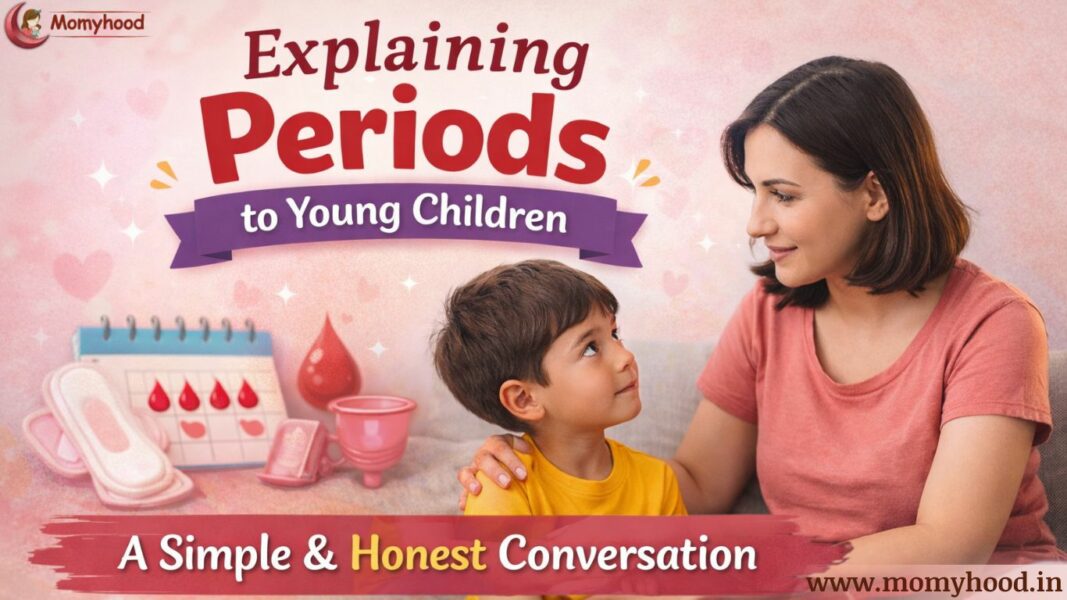
Today is the day to talk about ”that time of the month.”
The Moment That Sparked the Conversation
Many parents struggle with explaining periods to young children, worried about saying too much or too little. I’m glad that I got the perfect moment today.
Today, I was talking to my husband about my periods when my 6.5-year-old son, Hitarth, looked up at me with curious eyes and asked, “Mumma, what are periods?”
I felt a wave of happiness wash over me. This was it – the moment I’d been waiting for!
Honestly, I’ve wanted to explain this to him for a while now. When he was 4 or 5, I’d think about bringing it up, but I could never find the right way or the right time. The words would form in my mind, but I’d hesitate. Was he too young? Would I confuse him? Should I wait for him to ask?
But today, when he asked that simple question, I realized – this was the right time. Not because of his age, not because I had the perfect script prepared, but because he was curious and I was there to answer.
Explaining periods to young children doesn’t have to wait for a “perfect moment” – sometimes the best moment is when they ask.
So I smiled and decided: today is the day.
📣 Loved what you read? Want to go deeper into conscious parenting? ✨ The Power of Manifestation in Parenting is now available — A soulful guide packed with real-life tools like affirmations, energy shifts, and sleep talk that I personally use with my son, Hitarth. 💛 Start your journey toward calmer, connected parenting today. 🎉 Launch Offer: Only ₹99 (limited-time price!) 📲 Instant download. No waiting. 👉 Grab your copy now!.
Why I Decided to Have This Conversation
You might wonder why I chose to talk about menstruation with such a young child. Explaining periods to young children isn’t something most parents think about doing, especially with boys, but here’s why I felt it was important:
Normalizing Natural Body Functions: I wanted Hitarth to grow up understanding that periods are a normal, healthy part of life, not something mysterious, shameful, or gross. By explaining periods to young children early in a calm, matter-of-fact way, I’m helping him develop a healthy attitude toward women’s bodies and biology.
Building Trust and Open Communication: When children learn about body topics from their parents in an age-appropriate way, it establishes trust. I want Hitarth to know he can come to me with any questions about how bodies work, without feeling embarrassed or confused.
Preparing Him for Real Life: At some point, he might notice sanitary products in our bathroom, or see a family member dealing with period symptoms. Rather than leaving him confused or letting him develop incorrect ideas, I wanted to give him a simple, honest explanation.
Raising an Empathetic Person: I realized that explaining periods to young children, especially boys, helps them become more empathetic and respectful toward women throughout their lives. He won’t grow up thinking periods are something weird or taboo to giggle about.
A Little “Mommy Confession”: To be completely honest, I had one more tiny reason for this talk—and it’s a bit of a confession! I wanted Hitarth to understand that on some days, Mumma might feel a little extra tired or need a bit more rest. I told him, “Sometimes during my period, my tummy might ache a little, so I might need some extra cuddles or a little help from my brave boy.”
I’ll admit, I wanted a little extra care from him! And it worked. Seeing his little face fill up with concern and love was the best part. Now, instead of wondering why Mumma is resting on the sofa, he knows he can be my little helper. It’s a win-win!
This conversation also made me reflect on how deeply society celebrates male bodies while shaming female ones from birth. I’ve written more about this conditioning in my blog Boys Bring Joy, Girls Bring Tears: Penis You Celebrate & Vagina You Mourn?, where I explore how early these biases begin — often without us even realizing it.
How I Explained It
I kept my explanation simple and age-appropriate. Here’s what I told him:
“You know how your body is always growing and changing? Well, girls’ and women’s bodies have something special that happens to help them be able to have babies when they grow up.”
His eyes widened immediately. “But Mumma, why only girls have this special thing? Why only they can have babies in their tummies?”
LOL! Leave it to a 6-year-old to ask the most profound questions with such innocent directness. I smiled and said, “Because God chose us for this special job!”
That seemed to satisfy him, so I continued:
“Inside a woman’s body, there’s a special place called the uterus – it’s like a cozy room where a baby could grow someday. Every month, the uterus stores a lot of blood to protect and help create a baby, just in case a baby starts growing there.”
Now, I know this isn’t technically accurate. The uterus doesn’t actually “store blood” – it builds up a special lining made of tissue and blood vessels that can nourish a fertilized egg. But at 6.5 years old, Hitarth doesn’t need to understand eggs, fertilization, ovulation, and all those complex biological processes. I deliberately simplified it because my goal was to give him a basic understanding he could grasp, not to teach him reproductive biology. There would be plenty of time for more accurate details as he grows older and his comprehension develops.
“But most months, there’s no baby, so the body doesn’t need all that blood anymore. The uterus can’t store so much blood, so the body cleans it out and sends it away every month. That’s called a period or menstruation.
It’s totally normal and healthy – it just means the body is working the way it should! It happens about once a month for most women and older girls, and it lasts for a few days. It doesn’t hurt most of the time, though sometimes tummies can feel a little uncomfortable, like when you eat too much.
The important thing to know is that periods are a normal, healthy part of growing up for girls, and there’s nothing scary or weird about them. It’s just the body doing its job!”
“But Mumma, where does the blood go?”
After I explained what a period is, Hitarth had a very practical question. He looked at me and asked, “But where does all that blood go? Doesn’t it make a mess?”
I realized that if I didn’t explain how we stay clean, he might think it’s a scary or messy thing. So, I kept it simple.
I told him, “Just like we use a tissue when we have a runny nose, women use special things to stay clean. Some use pads (which are like soft cushions), and some use menstrual cups.”
Since I use a cup myself, I told him how it works and how I wash it to keep it clean. I’ll be honest—I was a little nervous! I thought he might say “yuck” or ask a hundred more questions.
But he was totally fine with it. He just nodded and said, “Oh, okay!”
To him, it wasn’t “gross” at all. It reminded me that kids don’t have the taboos we adults do—to him, it was just like learning how we use a towel after a bath. Because I wasn’t embarrassed to talk about it, he wasn’t embarrassed to hear about it. It was just another way we take care of our bodies.
Taking It Further: The Dr. Binocs Video
After my explanation, I wanted to reinforce what he’d learned, so I showed him a Dr. Binocs video about periods. The video explained menstruation in a child-friendly way, covering topics like:
- The menstrual cycle as a natural biological process
- How puberty typically begins between ages 8 to 15
- The role of ovaries, estrogen, and ovulation
- How the uterine lining sheds when an egg isn’t fertilized
- That periods are neither disgusting nor embarrassing
- That other female mammals like monkeys and elephants also menstruate
After showing him the video, I felt even more confident that explaining periods to young children early sets a foundation for healthy conversations about bodies and puberty in the future.
Want to reinforce your explanation? This is the Dr. Binocs video I used with Hitarth.
His Reaction
Hitarth’s response was heartwarming. When the video covered the information I’d already explained to him, he got excited and said, “Yes, Mumma! You told me this!” It was a wonderful moment of validation for both of us.
However, the more technical explanations in the video about eggs and ovulation were a bit over his head. He didn’t fully grasp those details, and that’s completely okay. I reassured him by saying, “When you’re a little bit older, you’ll understand it more. For now, the important thing is that you know what periods are.”
And honestly? He understood the basics, which is exactly what I was hoping for at his age.
This experience helped me understand that explaining periods to young children early helps them see it as just another normal part of life, not something mysterious or taboo.
A Helpful Resource for You
If you want to start this conversation with your kids but aren’t sure how to find the right words, there is a book I’ve heard wonderful things about called the Menstrupedia Comic.
To be honest, I have never bought or used this book myself, because Hitarth is still young and our simple chat was enough for now. However, I have heard a lot of great reviews about it. It’s a comic-style book that explains periods and growing up in a very friendly, easy-to-understand way. Even organizations like TIME and Melinda Gates have praised it for making a tough topic easy.
If you have a daughter or an older child and feel like you need a “guide” to help you out, this could be a great resource to check out. In my case, I didn’t feel the need for it yet, but it’s always good to know there are tools out there to help us parents!
A Private Family Conversation
Before we finished our chat, I made sure to tell him one more important thing.
I said, “Hitarth, this is a special ‘family topic.’ If you ever have more questions or feel curious, you can always come to me or Papa. But remember, this isn’t something to talk about with your friends at school right now.”
I explained that because everyone learns about their bodies at different times, some of his friends might not know about this yet, and it might confuse them. He understood perfectly.
By setting this boundary, I’ve made sure he knows that our home is a safe space for all his questions, while also teaching him that some topics are private and special.
My Takeaway
Looking back, I’m so glad I didn’t overthink it & had this conversation with Hitarth. Explaining periods to young children doesn’t require a medical degree – just honesty, simplicity, and love.
I don’t think there’s a “perfect age” for explaining periods to young children, but I do believe in:
- Following your child’s curiosity and readiness
- Keeping explanations age-appropriate
- Being honest and matter-of-fact
- Normalizing body functions from an early age
- Building a foundation for more detailed conversations later
By having this conversation now, I’ve planted seeds of understanding, empathy, and body positivity. As Hitarth grows, we’ll continue these conversations with more depth and detail. But for today, I’m proud that my young son knows that periods are just a normal part of how bodies work, nothing more and nothing less.
If you’re considering having similar conversations with your children, I encourage you to trust your instincts as a parent. Whether you have sons or daughters, these conversations matter. You know your child best, and any step toward open, honest communication about bodies is a step in the right direction.
The journey of explaining periods to young children doesn’t have to be perfect or follow a script. It just needs to be honest, age-appropriate, and filled with love. And that’s something every parent can do.
Your comments and shares do more than just support our blog—they uplift the amazing moms who share their stories here. Please scroll down to the end of the page to leave your thoughts, and use the buttons just below this line to share. Your support makes a big difference!