
🔄 Last updated: March 2026 — refreshed with current tips to help you raise environmentally conscious children in today’s world.
Little children love nature. A child thinks a cockroach is beautiful — until an adult says otherwise.
That one observation tells you everything you need to know. The instinct to connect with the earth is already inside your child. Your only job is to not take it away.
As Earth Day (April 22nd) comes around each year, let’s talk about the most practical, guilt-free ways to raise environmentally conscious children — without long lectures, without pressure, and without turning every walk in the park into a classroom.
I promise this will be a quick read. You’re a busy parent. Let’s get to what actually works.
Why Now Is the Right Time to Raise Environmentally Conscious Children
Children are the most natural scientists on the planet. They will watch an ant trail for twenty minutes straight. They ask “why” until you’re Googling answers at midnight. They love mud, and seeds, and crawly things.
What they are not born with is the habit of wasting, discarding, and ignoring the world around them. That, unfortunately, is learned — from us.
📣 Loved what you read? Want to go deeper into conscious parenting? ✨ The Power of Manifestation in Parenting is now available — A soulful guide packed with real-life tools like affirmations, energy shifts, and sleep talk that I personally use with my son, Hitarth. 💛 Start your journey toward calmer, connected parenting today. 🎉 Launch Offer: Only ₹99 (limited-time price!) 📲 Instant download. No waiting. 👉 Grab your copy now!.
The good news is you don’t need to undo much. You simply need to model what you want them to mirror.
Children have keen eyes, sharp ears, and are excellent behavioral sponges. If you carry a cloth bag to the grocery store, they will carry one too — without being asked, within weeks. If you switch off the lights when you leave a room, they will start reminding you when you forget.
That’s the magic of starting young.
The 5 R’s: The Simplest Framework to Raise Environmentally Conscious Children
Forget complicated eco-routines that burn out in a week. This one framework covers everything — and your children will actually remember it.
Teach them: Reduce. Reuse. Recycle. Restore. Replenish.
Reduce — Start Right at the Dinner Table
Food waste is one of the biggest environmental problems in the world. In India alone, nearly 67 million tonnes of food is wasted every year — almost one-third of everything produced.
The simplest lesson you can give your child? Take only what you can eat.
Want to make it really stick? Take them to a farm. Let them see how much effort goes into growing one bowl of rice or a handful of wheat. Once a child understands the human effort and nature’s energy behind every meal, wasting food starts to feel wrong — to them, not just to you.
You don’t need to say a word. Let the experience do the teaching.
Reuse — A Broken Toy Is Not Trash
When a toy breaks, resist the reflex to throw it away. Help your child fix it with glue. Or repurpose it into a school project. Let them feel the satisfaction of saving something.
When they’ve outgrown a toy, let them hand it to another child themselves. That moment of giving is something they carry for years.
The same principle applies to clothes. A cousin’s hand-me-downs are not “less than” — they are a story, a connection, a lesson in gratitude. Teaching this early saves money for your household and builds a child who is genuinely down-to-earth.
Recycle — That Old Notebook Is Not Done Yet
At the end of every school year, flip through the notebooks. There are always blank pages left.
Help your child turn those pages into a holiday journal, a scrapbook, or a drawing book for the summer. It costs nothing. It teaches everything.
This is also the perfect moment to introduce biodegradable vs. non-biodegradable waste — hands-on, without a single slide deck or YouTube video. Sort the kitchen waste together one afternoon. Make it a game, not a lesson.
Restore — Old Clothes Become the Best Keepsakes
Those tiny T-shirts your child has outgrown, the kurta that’s too faded to wear out — don’t dump them.
Turn them into a pillow cover, a small quilt, a tote bag, or a face mask. It’s a craft project for a slow Sunday afternoon. The result is something your child will treasure — and more importantly, it teaches them that things have more than one life.
Worn-out clothes that can’t be repurposed can be cut into cleaning cloths for the kitchen or windows. Simple, useful, and a powerful lesson in seeing value where others see waste.
Replenish — Give Back to the Earth, Together
This one is the most joyful of all five.
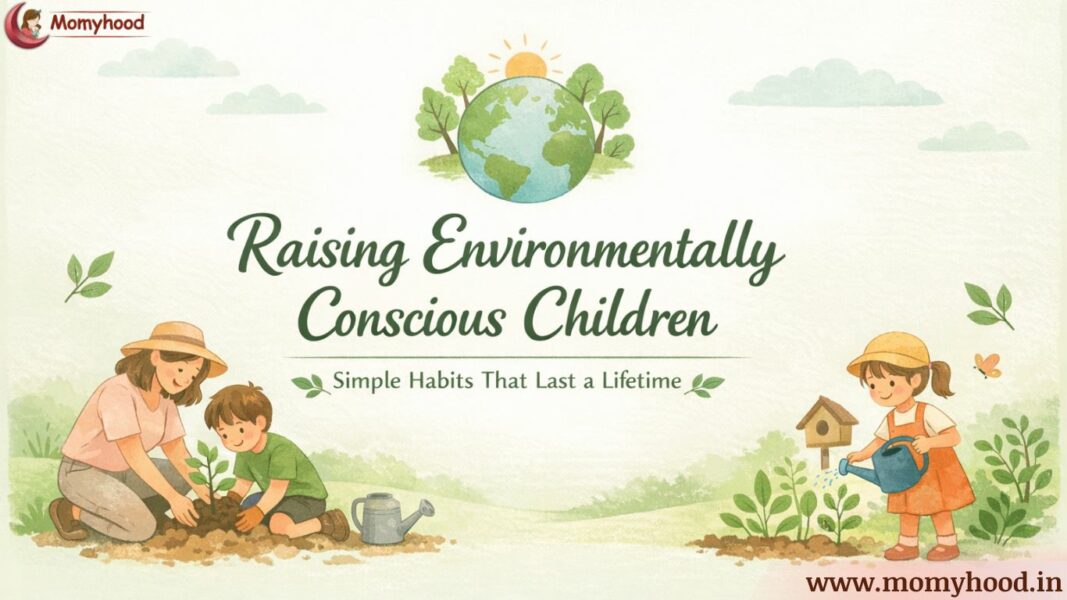
Plant a seed together. Put up a bird feeder outside the window. Walk to the park instead of driving. Let your child spend twenty minutes just watching — a butterfly, an ant, a cloud — with no screen in their hand and no schedule to rush to.
The COVID-19 lockdowns taught us something unforgettable: when we pause our consumption, the earth recovers visibly. Rivers cleared. Birds returned. Show your children the photographs from that time. That image is worth a hundred lessons.
We use far more than the earth can replenish. Involving children in acts of restoration — planting, feeding, segregating, walking — gives them a sense of agency. They feel like they matter to the planet. Because they do.
Related read: Turning Trash into Treasure: My Journey with Funda RRR
3 Daily Habits That Stick When You Raise Environmentally Conscious Children
Big values don’t always need big moments. Here is what works in a real, busy household:
- The Switch-Off Game. Who spots the light left on? Who remembers to switch off the fan? Turn it into a gentle family competition. Children who remind you to switch off the appliances have internalized the habit for life — not just for childhood.
- Weekly time in nature. Even twenty minutes in a park, feeding birds, planting something in a pot, or watching the sky. Nature teaches patience, curiosity, and wonder — things no classroom can fully replicate.
- A Carbon Diary. For every eco-action the family takes — walking instead of driving, not wasting food, watering plants — add a star or a sticker. Children love earning things. Give them something visible to earn, and they will keep going.
You don’t need to implement all three at once. Pick one this week. That’s enough to start raising environmentally conscious children who carry these habits into adulthood.
🌱 Want to make the 5 R’s hands-on and fun?
These two are parent favourites for getting children genuinely excited about nature:
- 👉 Kids’ Gardening Starter Kit (Amazon) → — Covers Replenish beautifully. A child who grows their own tomato will never see food the same way again.
- 👉 Nature Journal for Children (Amazon) → — Perfect for the Recycle and Restore habits. A child who draws what they observe outdoors will never stop being curious.
Both under ₹1000.
One Rule Every Family Needs When They Raise Environmentally Conscious Children
Here is something that often gets overlooked — and it matters more than any tip on this list:
Rotate the eco-responsibilities equally among all children in the house.
If one child always sorts the waste and another never does, the first child grows up carrying resentment — not values. Fairness is part of conscious parenting too.
Make it a family culture, not one child’s unpaid job. Everyone plants. Everyone sorts. Everyone switches off. That’s when it becomes identity, not just instruction.
Also read: Green Minds, Bright Futures: Teaching Sustainability in Primary Education
Start Small — When You Raise Environmentally Conscious Children, the Earth Notices
As Lady Bird Johnson once said, “Where flowers bloom, so does hope.”
You don’t need to overhaul your lifestyle overnight. You don’t need to be a perfect zero-waste family. You don’t need to have all the answers when your child asks “why is the sky getting hotter, Mama?”
You just need to say: “I don’t know yet. Let’s find out together.”
And then do it.
The small things — one cloth bag, one saved notebook, one planted seed, one switched-off light — are not small to the child who watches you do them. Those moments become their normal. And their normal becomes the world’s future.
That’s how we raise environmentally conscious children. One sincere, imperfect act at a time.
📚 Reading this made you want to go deeper?
Last Child in the Woods by Richard Louv is one of the most powerful books written for parents raising nature-connected children. It completely changed how I think about unstructured outdoor time — and why it matters more than any structured activity we sign our kids up for.
Written by Umayal Subramaniam — a parent, nature enthusiast, and contributor to Momyhood’s conscious parenting series. Her writing comes from real life, not research papers.
Your comments and shares do more than just support our blog—they uplift the amazing moms who share their stories here. Please scroll down to the end of the page to leave your thoughts, and use the buttons just below this line to share. Your support makes a big difference!