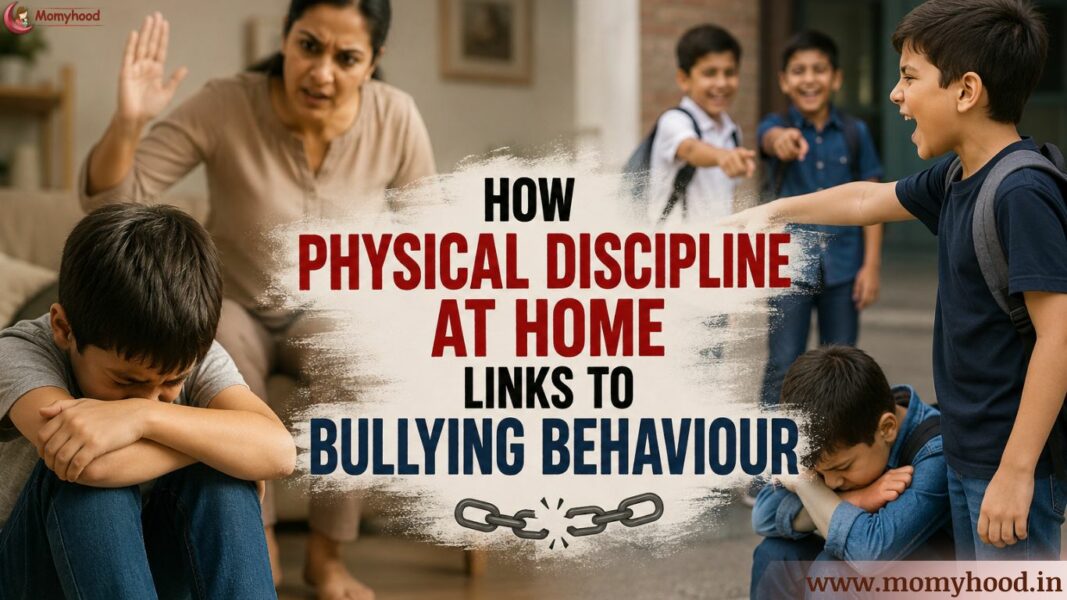
A few weeks ago, I came across a study that stopped me mid-scroll — it looked at how physical discipline at home links to bullying behaviour in children, and the findings weren’t something I could just read and move on from. As a mom who has spent a lot of time lately thinking about how to raise a child who doesn’t bully others and isn’t bullied himself, this felt like a piece I couldn’t skip, even though it made me sit with some uncomfortable questions about discipline.
I’ll be honest — this isn’t the easiest topic to write about, because it means looking closely at our own choices as parents, not just our children’s behaviour. But I think that’s exactly why it matters.
What the Research Actually Found
The study, reported on by The Guardian, looked at children who experienced physical punishment at home — things like smacking or hitting as a form of discipline — and found a meaningful connection with those same children being more likely to bully others later on. Researchers suggested that when a child regularly experiences physical force as a way adults handle frustration or misbehaviour, it can normalise the idea that hitting or physical dominance is an acceptable way to resolve conflict or assert control over someone else.
In other words, a child doesn’t just learn “don’t do that again” from being hit — they may also absorb a much bigger, unintended lesson: that when you’re upset or want to control a situation, physical force is a reasonable tool. And children, being the excellent imitators they are, often carry that lesson straight into the playground.
Why This Made Me Rethink My Own Approach to Discipline
I haven’t relied on physical discipline with my son, but I won’t pretend I’ve never come close in a moment of pure frustration — most parents I know have felt that flash of “I just want to swat that hand away” at some point. Reading about how physical discipline at home links to bullying behaviour made me realise how important it is that that flash of frustration never actually turns into action, and that I have other tools ready in that moment instead.
What I Do Instead When I’m at My Most Frustrated
I’ve learned that the moments right before I might raise my voice or hand are exactly the moments my son is watching most closely. So over time, I’ve built a few habits for those exact moments.
📣 Loved what you read? Want to go deeper into conscious parenting? ✨ The Power of Manifestation in Parenting is now available — A soulful guide packed with real-life tools like affirmations, energy shifts, and sleep talk that I personally use with my son, Hitarth. 💛 Start your journey toward calmer, connected parenting today. 🎉 Launch Offer: Only ₹99 (limited-time price!) 📲 Instant download. No waiting. 👉 Grab your copy now!.
1. I Name My Own Frustration Out Loud
Instead of letting frustration build silently until it explodes, I say it plainly — “I’m getting really frustrated right now, I need a second.” This does two things: it lets me actually pause, and it shows my son that frustration is something you name and manage, not something you act out physically.
Him: “Are you angry at me?”
Me: “I’m angry about the shouting, not at you. Let’s both calm down first.”
2. Consequences, Not Force
Instead of physical punishment, I’ve leaned on natural or logical consequences — if a toy is thrown in anger, it gets put away for the day. If screen time turns into a fight, screen time ends early. These consequences are firm, but they don’t involve force, and they still make it very clear that the behaviour has a real result.
3. I Talk About the “Why” Behind Rules, Not Just Enforce Them
Rather than only saying “don’t hit your cousin,” I try to explain why — “hitting hurts people, and it doesn’t solve the disagreement, it just adds a new problem.” Children who understand the reasoning tend to internalise the rule rather than just avoiding punishment.
How This Connects Back to Bullying Specifically
This is really where the research became personal for me. If part of how physical discipline at home links to bullying behaviour is about children learning that force is a valid way to get what they want or express frustration, then the opposite must also be true — a child who’s shown that conflicts can be resolved through words, consequences, and calm conversation is far less likely to reach for force when he’s frustrated with a peer.
I noticed this recently when my son (now 7) got frustrated with a friend who kept interrupting him while he was explaining a game’s rules. My old worry would have been him pushing the friend out of frustration. Instead, he said, quite firmly, “You need to let me finish talking, that’s not fair,” and walked a few steps away until he’d calmed down. That response didn’t come from nowhere — it came from years of me showing him that frustration gets spoken, not acted out physically.
Related read: How school, online bullying affect your child and how to detect warning signs
Discipline Without Force Is Still Discipline
I think one misconception that keeps physical discipline alive in many households is the idea that without it, there’s no discipline at all — that children will simply do as they please. In practice, I’ve found the opposite. Boundaries held firmly, consistently, and calmly tend to be respected more, not less, because the child isn’t complying out of fear of pain, but out of understanding and trust.
What I’d Want Other Parents to Take From This
I’m not writing this to make any parent who has used physical discipline feel attacked — most of us are doing our best with the tools we grew up seeing ourselves. But understanding how physical discipline at home links to bullying behaviour has genuinely changed how I handle my own frustrating parenting moments, because I now see those moments as ones my son is quietly learning from, not just reacting to.
If there’s one thing I’d want another mom to sit with after reading this, it’s this — the way we handle our own anger in front of our children often becomes the exact way they’ll handle theirs with someone else. And if that’s true, then choosing calm over force isn’t just about parenting gently. It might genuinely be one of the most protective things we can do for how our children treat others, and how others treat them.
Your comments and shares do more than just support our blog—they uplift the amazing moms who share their stories here. Please scroll down to the end of the page to leave your thoughts, and use the buttons just below this line to share. Your support makes a big difference!