

I still remember the evening my seven-year-old, sat cross-legged on his bed, eyes squeezed shut, “wishing really hard” for his skating competition to go well the next day. I didn’t correct him or explain the mechanics of visualization. I just sat beside him and asked, “What do you see happening?” That one question changed how I started to teach manifestation to kids in our home — not as magic, but as a mindset.
If you’re a parent who practices manifestation yourself and wonders whether — or how — to pass it on to your child, you’re not alone. I get asked this often, and I realized it deserved its own space here on Momyhood, where I can go deeper into the practical, everyday version of this practice.
This isn’t about promising your child that wishing hard enough will make anything appear. It’s about something far more useful: helping kids build the habit of clarity, gratitude, and self-belief — skills that quietly shape how they handle disappointment, effort, and hope as they grow.
What Does It Really Mean to Teach Manifestation to Kids?
Before I go further, let me be honest about what I mean by this term, because I think a lot of well-meaning content overpromises. When I teach manifestation to kids, I’m not teaching my son that the universe will drop a new bicycle on our doorstep because he thought about it hard enough. That’s not fair to him, and it sets kids up for confusion when life doesn’t cooperate.
What I am teaching him is this: notice what you want, picture yourself doing the work to get there, believe it’s possible, and then actually show up for it. Manifestation, stripped of the mysticism, is really a blend of intention-setting, visualization, and follow-through — and children are naturally good at all three, if we don’t get in their way.
The Three Building Blocks I Use With my son
1. Clarity — helping him name exactly what he wants, instead of vague wishing.
2. Visualization — picturing himself succeeding at it, in detail.
3. Action + Gratitude — pairing the wish with effort, and noticing what’s already going right.
📣 Loved what you read? Want to go deeper into conscious parenting? ✨ The Power of Manifestation in Parenting is now available — A soulful guide packed with real-life tools like affirmations, energy shifts, and sleep talk that I personally use with my son, Hitarth. 💛 Start your journey toward calmer, connected parenting today. 🎉 Launch Offer: Only ₹99 (limited-time price!) 📲 Instant download. No waiting. 👉 Grab your copy now!.
Why I Started Teaching Manifestation to My Son
My son is naturally a bit anxious before new things — a new sport, a school presentation, meeting new classmates. I noticed that when he spiralled into “I can’t do this,” his performance actually got worse. But on the days he’d say, even jokingly, “I already know I’m going to do well,” something shifted in his energy. He stood taller. He tried harder.
That’s when I realized this wasn’t just spiritual practice for me anymore — it was a genuine parenting tool. Teaching manifestation to kids, at its core, is teaching them to control their internal narrative before the world hands them one.
Age-Appropriate Ways to Teach Manifestation to Kids
One mistake I made early on was borrowing language from adult manifestation content — talking to him about “raising his vibration” or “aligning with the universe.” He looked at me like I’d grown a second head. Kids need concrete, playful language, not spiritual jargon. Here’s what has actually worked in our house.
1. The “Movie in My Mind” Game
Before his matches, exams, or even a birthday party he’s nervous about, I ask him to close his eyes and “play the movie” of how he wants it to go. What does he see himself doing? What does his face look like when it goes well? This is visualization, just dressed in language a child understands.

2. The Gratitude Jar
Every night, he drops a small chit into a jar with one thing that went right that day — big or small. This isn’t directly manifestation, but it trains the brain to notice progress and good outcomes, which is the emotional foundation manifestation is actually built on.

3. Wish, Then Plan
Whenever he tells me he “wants” something — to win a school race, to make a new friend, to get better at drawing — I don’t just nod along. I ask, “Okay, what’s one thing you can do today toward that?” This single follow-up question is, in my experience, the single most important part of teaching manifestation to kids honestly. It stops the practice from becoming passive wishing.

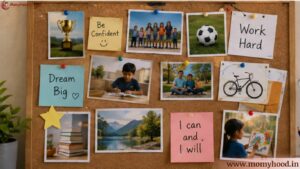
4. A Simple Vision Board
On a lazy Sunday, my son and I made a small vision board together with magazine cutouts and drawings — a cricket bat, a friendly-looking group of kids, a big smiley face. It now sits above his study table. He glances at it without me having to say a word.
5. Affirmations as Bedtime Ritual
We started with one simple line at bedtime: “I am capable, I am kind, and good things come to me when I try.” It’s short enough for a seven-year-old to remember and repeat on his own now, some nights without any prompting from me.

Also read: 5 Manifestation Techniques for Kids: My Go-To Practices for Raising Happy & Confident Children
Common Mistakes Parents Make When Teaching Manifestation to Kids
I’ve made a few of these myself, so I say this gently, not from a place of judgment.
- Promising outcomes instead of mindset. Telling a child “you’ll definitely win” sets them up to feel manifestation “failed” when they don’t. I now frame it as “you’ll show up as your best self,” which is something within their control.
- Skipping the action step. Manifestation without effort teaches magical thinking, not resilience. I’m careful to always pair a wish with a next step.
- Using adult spiritual vocabulary. Kids don’t need to understand energy or the universe to benefit from this practice. Simple words work better.
- Making it another pressure to perform. If manifestation becomes one more thing your child has to “get right,” it stops being helpful. I keep it playful, never a chore.
How This Connects to Emotional Resilience
What surprised me most, watching him over the past year, is that this practice isn’t really about getting things. It’s about how he recovers when things don’t go his way. When his team lost a match he’d visualized winning, he was disappointed, but he didn’t fall apart the way he used to. He said, “I did my best, next time I’ll picture it even more.” That, to me, is the real gift of teaching manifestation to kids — not guaranteed outcomes, but a steadier relationship with effort and hope.
Frequently Asked Questions
At what age can I start teaching manifestation to kids?
Even preschoolers can start with simple gratitude practices and “movie in my mind” style visualization. The language just needs to get simpler the younger the child is — think pictures and feelings, not concepts like energy or vibration.
Isn’t this just setting kids up for disappointment?
Only if it’s taught as a guarantee. When framed as mindset-plus-effort, it actually builds resilience, because children learn to separate their effort (which they control) from the outcome (which they don’t).
Do I need to explain the “law of attraction” to my child?
No. Concepts like this can wait until they’re older, if at all. Young children respond far better to simple, concrete practices than abstract spiritual theory.
What if my child’s wish doesn’t come true?
This is exactly why the “wish, then plan” step matters. It shifts the conversation from “why didn’t it work” to “what did I learn, and what will I try next,” which is a far more useful lesson for life.
Related read: How to talk to kids about manifesting
My Honest Takeaway
I didn’t set out to teach manifestation to kids as some structured curriculum. It grew out of ordinary bedtime conversations and a gratitude jar that started as a way to fill five quiet minutes before sleep. What I’ve learned is that children don’t need the philosophy explained to them — they need small, repeatable rituals that let them practice hope and effort side by side.
If you’re a parent curious about this, start small. Pick one practice from this list — the gratitude jar or the movie-in-my-mind game are the easiest entry points — and let it become a habit before adding anything else. The goal was never to raise a child who expects the universe to do the work. It was to raise a child who believes he’s capable of doing it himself, with a little hope in his back pocket.
Have you tried teaching manifestation or mindset practices with your kids?
I’d love to hear what’s worked in your home — drop a comment below for more conscious parenting conversations.
Your comments and shares do more than just support our blog—they uplift the amazing moms who share their stories here. Please scroll down to the end of the page to leave your thoughts, and use the buttons just below this line to share. Your support makes a big difference!