
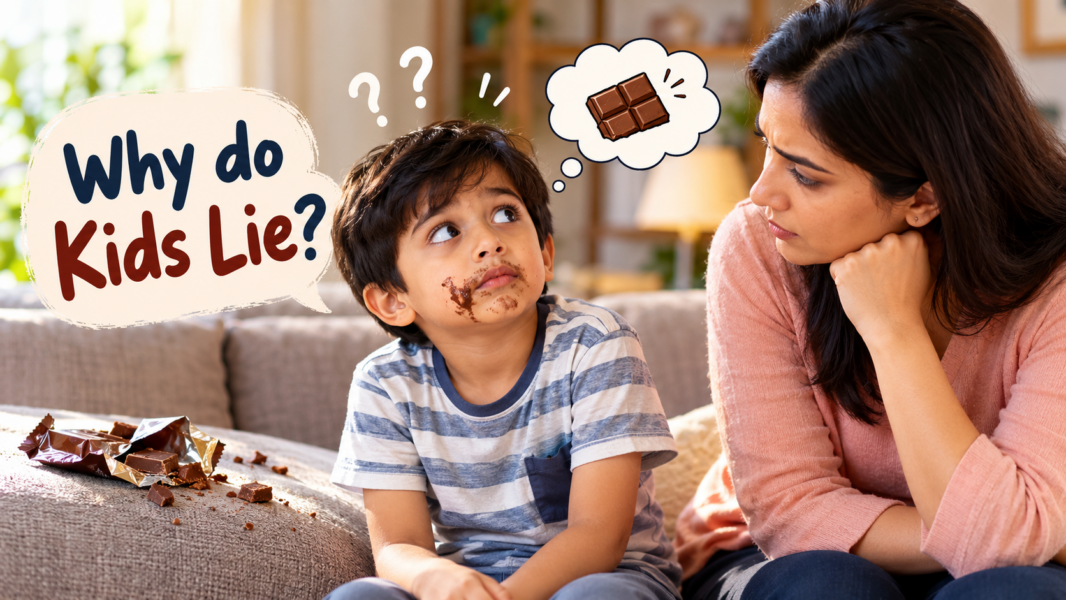
The empty chocolate wrapper was lying on the sofa. Chocolate was smeared across his cheek.
“Did you eat the chocolate?”
“No, Mummy. I didn’t.”
I remember standing there with a strange mix of anger and heartbreak. It was not about the chocolate. It was about the calm, steady way he said it. If you have ever asked yourself why kids lie, especially when the truth is written all over their faces, you are in good company. I asked myself the same question for weeks, and the answer changed how I speak to Reyansh.
My first reaction was the wrong one
That day, I did what felt natural. I raised my voice, I said “Do not lie to me,” and I made him sit in his room and think about what he had done. By evening, he was sulking and I was exhausted. And a few days later, there was another small lie about homework.
That is when I realized my approach was not teaching honesty. It was teaching Reyansh to hide better. Each time I turned a lie into a trial, with questions, accusations and a punishment waiting at the end, I made the truth feel more dangerous than the fib.
📣 Loved what you read? Want to go deeper into conscious parenting? ✨ The Power of Manifestation in Parenting is now available — A soulful guide packed with real-life tools like affirmations, energy shifts, and sleep talk that I personally use with my son, Hitarth. 💛 Start your journey toward calmer, connected parenting today. 🎉 Launch Offer: Only ₹99 (limited-time price!) 📲 Instant download. No waiting. 👉 Grab your copy now!.
Why kids lie: what causes a child to start lying?
When I calmed down and began to observe, I noticed that Reyansh’s lies almost always had a reason behind them. I am not an expert in child psychology, but these are the patterns I saw at home, and they match what many parenting writers describe.
- Fear of getting into trouble. This was the biggest one. If the consequence of the truth feels scary, a young child will grab the nearest escape.
- Wanting to please us. Sometimes a child says “Yes, I finished my homework” because he does not want to disappoint his mother.
- Imagination mixing with reality. Small children often tell tall stories about monsters under the bed or a pet they never had. This is not lying with bad intent. It is play.
- Wishful thinking. “I did not spill the milk” can really mean “I wish I had not spilled the milk.”
- Testing boundaries. Children are curious about what happens when they say something untrue, and how we will react.
- Needing attention. An exciting made-up story sometimes brings more attention than an ordinary day.
Once I looked at lying this way, I stopped asking “What is wrong with my child?” and began asking “What is he afraid of right now?”
Related read: How to Deal with a Lying Child: A Mother’s Honest Journey
My 5-year-old is constantly lying. Is this normal?
I asked myself this exact question when Reyansh was five, and from what I have read and seen, the answer is yes, it is very common. Between the ages of four and six, children are discovering that their thoughts are private and that they can say something that is not true. They also slip easily between imagination and reality. So a five-year-old who insists the dog ate his drawing is often experimenting, not plotting.
Many experts note that fibbing in the early years is linked to growing thinking skills, because a child has to understand that other people do not know what he knows. That does not mean we should shrug it off. It means we can respond with teaching instead of shame. A child who lies is almost never a child with bad character. He is a child who has not yet learned a better way to handle a hard moment.
What to do when you find your child lying, without turning it into a trial
Here is what changed in our home. The shift was small but powerful: I stopped asking questions I already knew the answer to.
If I can see the wrapper and the chocolate on his cheek, asking “Did you eat it?” only gives him a chance to lie again. So I say it plainly and gently, “I can see you ate the chocolate. I would like to hear what happened.” That takes away the trap.
| What I used to say | What I say now |
|---|---|
| “Why are you lying to me?” | “I can see something is worrying you. Tell me what happened.” |
| “I will never trust you again.” | “I trust you, and it feels hard when the story changes.” |
| “Go to your room and think about it.” | “Let us sit together and fix this.” |
| “You are such a liar.” | “You told something untrue. That is a mistake, and you can try again.” |
Notice that I never call him a liar. Labels stick. A child who hears “liar” often enough may start to believe it.
Three habits that built honesty in our home
1. Reward the truth, even when it is uncomfortable. When Reyansh admitted he had broken a glass, I thanked him first for telling me. The glass was only a glass. His honesty was worth far more.
2. Make the consequence small and fair. If the truth brings a huge punishment, children learn to avoid it. A calm, small consequence, like helping clean up, teaches responsibility without fear.
3. Be honest myself. Children watch us closely. When I told a small white lie on the phone, “Tell them I am not home,” Reyansh noticed. I had to look at my own habits too.
Also read: An Age-by-Age Guide to Why Kids Lie (And How to Deal With It)
What is compulsive lying?
Compulsive lying, sometimes called pathological lying, means lying that has become a habit. The child lies even when there is no reason or benefit, tells untrue stories about ordinary things, and keeps doing it despite calm, consistent responses from the adults around him. It is very different from the occasional fib about a chocolate or homework, and most children are nowhere near this.
I cannot diagnose anything, and nobody can from a blog. But these are signs that make it worth speaking to your pediatrician or a child psychologist:
- Lying is constant, even about small things where the truth would cause no trouble.
- Your child seems unable to stop, even when he is caught.
- He also seems anxious, withdrawn or is struggling at school or with friends.
- He hides things that worry you.
Sometimes there is a deeper reason that needs support, and there is no shame in asking for help.
What I want Reyansh to remember
I do not want Reyansh to be honest because he is scared of me. I want him to be honest because he knows that, whatever he has done, he can walk to his mother and say it. That safety is what slowly makes a child truthful.
Learning why kids lie did not make me excuse the lies. It made me a calmer, wiser parent who could address the real problem underneath. If you are in the middle of a lying phase right now, take a breath. Stay curious instead of furious, make the truth feel safe, and give your child time to grow into it.
Has your child ever told a lie that made you laugh or worry? How did you handle it? Share your story in the comments below. Another parent may need to hear it today.
Your comments and shares do more than just support our blog—they uplift the amazing moms who share their stories here. Please scroll down to the end of the page to leave your thoughts, and use the buttons just below this line to share. Your support makes a big difference!