At my son’s ninth birthday party, he opened a pile of gifts in ten minutes, tossed most aside and asked, “Is that all?” Then he had a meltdown because his cousin got a bigger cake last year. I felt embarrassed – and a little scared. Was I raising a child who would never feel enough? That night I read Bhagavad Gita Chapter 16, where Krishna names three gates that lead to self-destruction: desire, anger and greed.
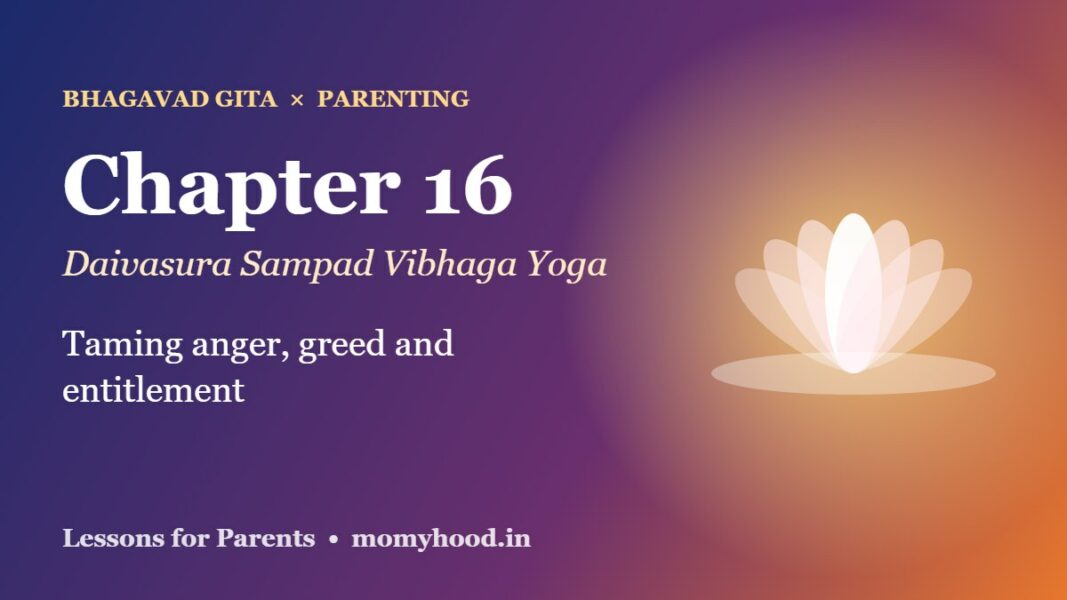
Bhagavad Gita Chapter 16, Daivasura Sampad Vibhaga Yoga, contrasts divine qualities with demonic ones. It is one of the most direct chapters on character. For parents navigating entitlement, tantrums and a culture of “more”, it offers both a warning and a clear list of qualities to nurture instead.
Quick answer: Bhagavad Gita Chapter 16 lists divine qualities – fearlessness, purity, self-control, forgiveness, truthfulness and humility – and contrasts them with demonic ones like pride, arrogance and anger. Verse 16.21 calls desire, anger and greed the three gates to self-destruction. For parents, it is a practical guide to raising grounded, grateful children.
Key takeaways
- Desire, anger and greed are the three gates to avoid
- Divine qualities can be nurtured daily at home
- Entitlement grows when every want is met instantly
- Model gratitude, patience and forgiveness
What Is Bhagavad Gita Chapter 16 (Daivasura Sampad Vibhaga Yoga) About?
Bhagavad Gita Chapter 16 opens with a list of 26 divine qualities: fearlessness, purity of heart, steadiness in knowledge, charity, self-control, study, austerity, honesty, non-violence, truthfulness, freedom from anger, renunciation, peacefulness, not finding fault, compassion, non-greed, gentleness, modesty, steadiness, vigour, forgiveness, fortitude, cleanliness, lack of malice and lack of pride (16.1–3).
Krishna then describes the demonic nature: hypocrisy, arrogance, pride, anger, harshness and ignorance, and people driven by endless desire who think, “Today I got this; tomorrow I will get that.” He warns that desire, anger and greed are three gates to hell that destroy the self, and must be abandoned (16.21). The chapter ends by urging us to let scripture and wisdom guide our choices. Chapter 16 has 24 verses.
📣 Loved what you read? Want to go deeper into conscious parenting? ✨ The Power of Manifestation in Parenting is now available — A soulful guide packed with real-life tools like affirmations, energy shifts, and sleep talk that I personally use with my son, Hitarth. 💛 Start your journey toward calmer, connected parenting today. 🎉 Launch Offer: Only ₹99 (limited-time price!) 📲 Instant download. No waiting. 👉 Grab your copy now!.
Key Verses From Bhagavad Gita Chapter 16 for Parents
Verse 16.21
त्रिविधं नरकस्येदं द्वारं नाशनमात्मनः।
कामः क्रोधस्तथा लोभस्तस्मादेतत्त्रयं त्यजेत्॥
Meaning: There are three gates to hell that destroy the self – desire, anger and greed. Therefore, one should give up these three.
For parents: These three show up in children every day – wanting more toys (kama), exploding when they don’t get them (krodha), and refusing to share (lobha). They are normal human tendencies, not signs of a “bad child”. Our job is to help children recognise these gates and learn to walk past them.
Read the full verse and commentary: Bhagavad Gita 16.21
Verse 16.3
तेजः क्षमा धृतिः शौचमद्रोहो नातिमानिता।
भवन्ति सम्पदं दैवीमभिजातस्य भारत॥
Meaning: Vigour, forgiveness, fortitude, purity, absence of malice and absence of excessive pride – these belong to one born with divine qualities, O Arjuna.
For parents: This is a list of qualities worth “investing” in. Children are not born fully formed; divine qualities grow through practice. Notice and praise forgiveness, patience under difficulty and humility – these are the real wealth (sampad) the Gita talks about.
Read the full verse and commentary: Bhagavad Gita 16.3
A Real-Life Example: The Wish List Rule
After the birthday meltdown, I tried something new – the “Wish List Rule”. Whenever my son wanted something, he wrote it on a list on the fridge. If he still wanted it after 30 days, we discussed it. Most items disappeared from his mind within a week. We also started a monthly “give-away box” – one toy or book he no longer used went to a child who needed it.
The anger took longer. We created a “cool-down corner” with a pillow, a drawing pad and a picture of Krishna playing the flute. When the second gate – anger – opened, he could go there before talking. A year later, at his tenth birthday, he opened gifts slowly and thanked each person. Afterwards he said, “Can I give two of these to the kids at Dadi’s building?” I almost cried. The gates were still there – they always will be – but he was learning to walk past them.
5 Parenting Lessons From Bhagavad Gita Chapter 16
1. Delay gratification
Instant fulfilment of every want feeds kama (desire). A wish list, waiting periods and saving pocket money teach children that wanting is fine – but waiting is strength.
2. Teach anger as a gate, not a crime
Help children notice the first signs of anger and give them tools – a cool-down corner, breathing, words. Punishing anger alone doesn’t teach regulation.
3. Practise generosity regularly
Lobha (greed) softens through giving. Make sharing, donating and helping a normal part of family life, not a one-time event.
4. Praise divine qualities
Notice when your child forgives a friend, stays patient, or tells the truth even when it’s hard. Call these out as real strengths.
5. Guard against pride
Children who are praised only for being “the best” can become arrogant. Balance praise with humility and gratitude.
How to Apply Bhagavad Gita Chapter 16 at Home (By Age)
- Toddlers (2–5 years): Name feelings (“You’re angry because…”) and offer simple calm-down tools. Practise sharing with timers and turns.
- Children (6–12 years): Use wish lists, pocket money and saving goals. Involve children in donating toys and helping others.
- Teenagers (13+): Discuss consumerism, social media envy and anger management openly. Let teens volunteer or contribute to causes they care about.
Common Mistakes Parents Make (and What the Gita Suggests Instead)
Giving in to tantrums
If anger gets results, children learn that the gate of krodha works. Stay calm and kind, but don’t reward the outburst.
Buying to compensate for guilt
Gifts to make up for absence teach children to equate love with things, feeding desire and greed.
Showing anger to stop anger
Shouting at a child to stop shouting models the very gate we want them to avoid.
Try This for 7 Days: A Bhagavad Gita Chapter 16 Practice
For seven days, start a family “three gates” check-in at dinner. Each person shares one moment they felt desire, anger or greed that day and how they handled it – parents first. Celebrate honest sharing, not perfection. Add one act of giving every day: share a snack, help a neighbour, donate an unused item.
What Modern Research Says
Research by psychologist Tim Kasser and colleagues has linked strong materialistic values to lower wellbeing, more anxiety and poorer relationships in both adults and children. Studies on emotion regulation show that children who learn to name and manage anger develop better social skills, and that harsh punishment of anger tends to increase aggression rather than reduce it.
Watch: Bhagavad Gita Chapter 16 Explained
Chaitanya Charan explains Chapter 16 – divine and demonic qualities and how they shape our lives.
FAQs About Bhagavad Gita Chapter 16 and Parenting
What is Bhagavad Gita Chapter 16 about?
It contrasts divine qualities (like fearlessness, compassion and humility) with demonic ones (like pride, arrogance and anger), and warns against the three gates of desire, anger and greed.
What are the three gates to hell in the Bhagavad Gita?
Desire (kama), anger (krodha) and greed (lobha), described in verse 16.21.
How can Bhagavad Gita Chapter 16 help with an angry or entitled child?
By teaching delayed gratification, emotion regulation and generosity, and by praising divine qualities like patience and forgiveness.
How many verses are in Chapter 16?
Bhagavad Gita Chapter 16 has 24 verses.
A Thought to Carry With You
Desire, anger and greed visit every home – in children and parents alike. Bhagavad Gita Chapter 16 doesn’t shame us for them; it names them clearly so we can choose another way. Teach your child to see the gates, and to walk calmly past them towards the treasure of divine qualities.
Reflect: Which of the three gates opens most often in your home – and what is one small habit that could help close it?
Read the Complete Bhagavad Gita Parenting Series
This article is part of Momyhood’s chapter-by-chapter series connecting all 18 chapters of the Gita with everyday parenting. Start anywhere – each chapter stands on its own.
- Chapter 1: Arjuna Vishada Yoga – When parenting overwhelms you
- Chapter 2: Sankhya Yoga – Do your best, let go of results
- Chapter 3: Karma Yoga – Children copy what we do
- Chapter 4: Jnana Karma Sanyasa Yoga – You are your child’s first guru
- Chapter 5: Karma Sanyasa Yoga – Balance work, home and inner peace
- Chapter 6: Dhyana Yoga – Self-control and a balanced routine
- Chapter 7: Jnana Vijnana Yoga – Understanding your child’s true nature
- Chapter 8: Akshara Brahma Yoga – Habits and thoughts shape who we become
- Chapter 9: Raja Vidya Raja Guhya Yoga – Love lives in small offerings
- Chapter 10: Vibhuti Yoga – Seeing the spark in every child
- Chapter 11: Vishwarupa Darshana Yoga – Facing fear about your child’s future
- Chapter 12: Bhakti Yoga – The patient, compassionate parent
- Chapter 13: Kshetra Kshetrajna Vibhaga Yoga – Your child is more than marks or looks
- Chapter 14: Gunatraya Vibhaga Yoga – Sattva, rajas and tamas at home
- Chapter 15: Purushottama Yoga – Roots and values that hold a family
- Chapter 16: Daivasura Sampad Vibhaga Yoga – Taming anger, greed and entitlement (you are here)
- Chapter 17: Shraddhatraya Vibhaga Yoga – Words that heal, not hurt
- Chapter 18: Moksha Sanyasa Yoga – Let your child find their own path
Related reads on Momyhood
- Managing anger in kids
- Teaching kids about money
- How I overcame my anger issues as a mom
- Building empathy in kids
- Bhagavad Gita lessons for parents (series overview)
Sources: Verse text and translations follow the Sanskrit original; see Gita Supersite, IIT Kanpur and Bhagavad Gita Chapter 16 (holy-bhagavad-gita.org). The parenting interpretations are Momyhood’s own reflections.
Your comments and shares do more than just support our blog—they uplift the amazing moms who share their stories here. Please scroll down to the end of the page to leave your thoughts, and use the buttons just below this line to share. Your support makes a big difference!