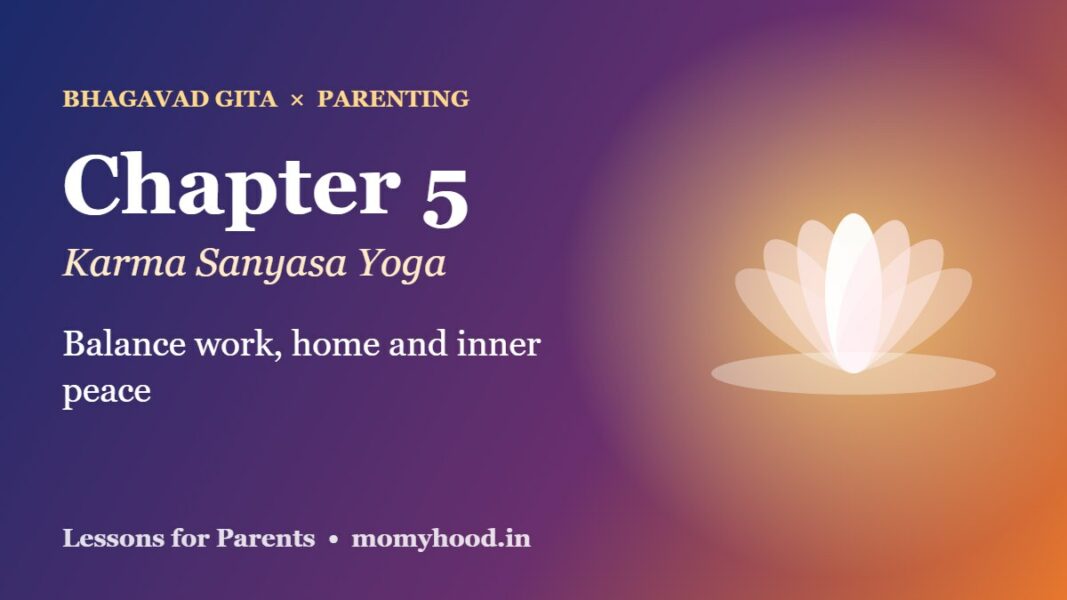
Every working parent knows the feeling. You are in a meeting but thinking about whether your child ate lunch. You are at the school function but checking office emails. You are everywhere and nowhere. When I first read Bhagavad Gita Chapter 5, one image stopped me: a lotus leaf sitting in water, but never getting wet. Could a parent live like that – fully involved, yet not drowning?
Bhagavad Gita Chapter 5, Karma Sanyasa Yoga, answers an old question: is it better to renounce action or to act? Krishna’s answer is practical and freeing – keep doing your work, but drop the inner clinging. For mothers and fathers juggling jobs, homes and children, this chapter is a guide to balance without guilt.
Quick answer: Bhagavad Gita Chapter 5 says acting without attachment is better than running away from action. Its lotus-leaf image (5.10) teaches parents to stay fully engaged with work and family without being drowned by stress, guilt or comparison. Verse 5.18 adds a reminder to see every child with equal love.
Key takeaways
- You don’t have to quit life to find peace – change your inner attitude
- Be like the lotus leaf: in the water, not soaked by it
- Share the “mental load” – inner peace needs practical support
- See each child with equal love and respect
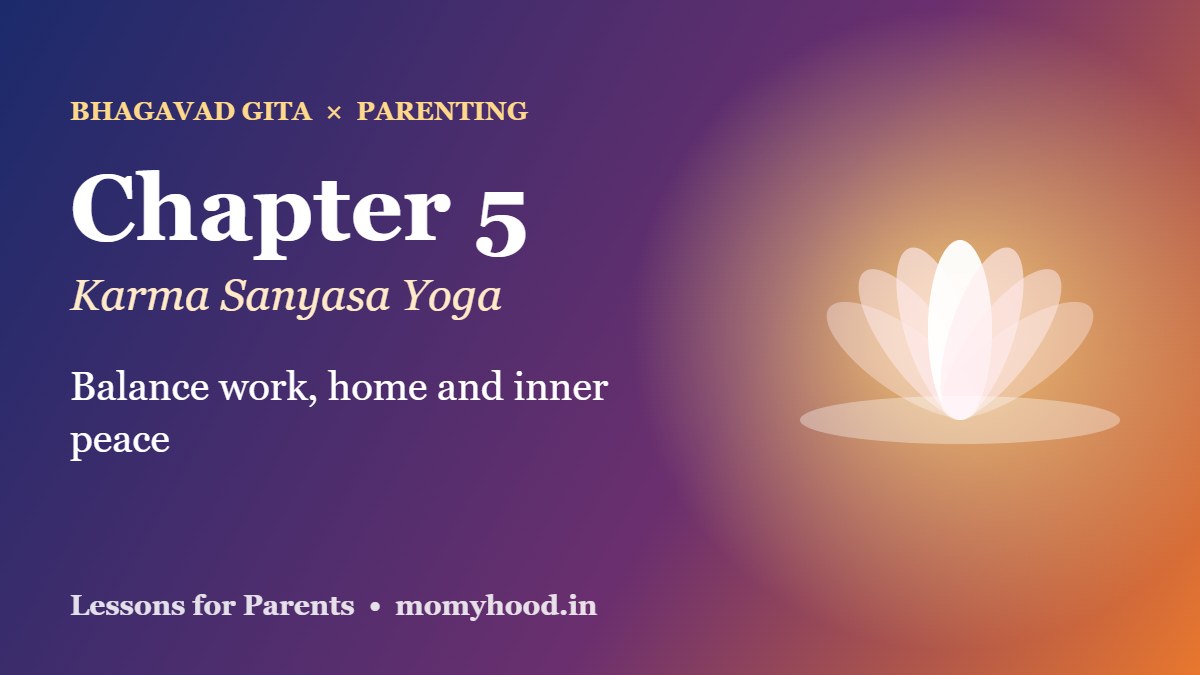
What Is Bhagavad Gita Chapter 5 (Karma Sanyasa Yoga) About?
Bhagavad Gita Chapter 5 begins with Arjuna asking a sharp question: Krishna has praised both renunciation and action – which one is better? Krishna says both can lead to freedom, but karma yoga – acting without selfish attachment – is better and easier for most people. Renouncing work outwardly while the mind keeps craving is not real renunciation.
The chapter describes the wise person who acts while inwardly free: who sees “I am not the doer” of every small thing, who offers results to the Divine, who treats all beings equally and finds happiness within rather than in sense pleasures. It closes with a short description of meditation that leads into Chapter 6. Chapter 5 has 29 verses.
📣 Loved what you read? Want to go deeper into conscious parenting? ✨ The Power of Manifestation in Parenting is now available — A soulful guide packed with real-life tools like affirmations, energy shifts, and sleep talk that I personally use with my son, Hitarth. 💛 Start your journey toward calmer, connected parenting today. 🎉 Launch Offer: Only ₹99 (limited-time price!) 📲 Instant download. No waiting. 👉 Grab your copy now!.
Key Verses From Bhagavad Gita Chapter 5 for Parents
Verse 5.10
ब्रह्मण्याधाय कर्माणि सङ्गं त्यक्त्वा करोति यः।
लिप्यते न स पापेन पद्मपत्रमिवाम्भसा॥
Meaning: One who offers all actions to the Divine and acts without attachment is not touched by sin, just as a lotus leaf is untouched by the water around it.
For parents: A working parent lives in “water” – deadlines, chores, school WhatsApp groups, family expectations. The lotus does not leave the pond; it simply doesn’t let the water soak in. You can do your work and care for your children fully, while refusing to let guilt and comparison soak into your mind.
Read the full verse and commentary: Bhagavad Gita 5.10
Verse 5.18
विद्याविनयसम्पन्ने ब्राह्मणे गवि हस्तिनि।
शुनि चैव श्वपाके च पण्डिताः समदर्शिनः॥
Meaning: The wise see with equal vision a learned and humble person, a cow, an elephant, a dog and an outcaste.
For parents: Sama-darshana – equal vision – is a powerful lesson at home. Children are very sensitive to favouritism: the “good student” and the “naughty one”, the son and the daughter, the elder and the younger. Seeing each child with equal love, while meeting their different needs, is the wise parent’s way.
Read the full verse and commentary: Bhagavad Gita 5.18
A Real-Life Example: The Lotus List
Farah, a software engineer in Hyderabad, felt she was failing at everything – work, motherhood and marriage. Her “to-do” list never ended, and every unfinished item felt like a judgement. A counsellor asked her to make a different list – two columns. On the left: things she can act on. On the right: things she must let go of, such as other people’s opinions, comparisons with other mothers on Instagram, and whether her son wins the drawing competition.
She also asked her husband to take full ownership (not “help”) of two areas: school communication and weekend meals. Within a month, the outer workload was a little lighter and the inner load was much lighter. “I still have a lot to do,” she says, “but I’m not drowning in it. I think of the lotus leaf every time I open the school WhatsApp group.”
5 Parenting Lessons From Bhagavad Gita Chapter 5
1. Change the attitude, not just the timetable
Krishna says renouncing action is not the answer – renouncing attachment is. Ask, “Which worries am I carrying that I can’t actually control?” and practise letting them go.
2. Divide the mental load fairly
Inner peace is easier when the practical load is shared. Make the invisible work – planning, remembering, organising – visible, and divide whole areas of responsibility.
3. Drop guilt about working
A working parent who acts with love is not neglecting their child. Quality presence – focused time without phones – matters more than counting hours.
4. Practise equal vision with siblings
Avoid labels like “the clever one” or “the troublemaker”. Spend one-on-one time with each child and never compare them.
5. Find happiness within
Chapter 5 says the wise find joy inside, not in sense pleasures. Children who see parents enjoying simple things – a walk, music, prayer – learn that happiness doesn’t depend on buying things.
How to Apply Bhagavad Gita Chapter 5 at Home (By Age)
- Toddlers (2–5 years): Keep simple, predictable routines so transitions (daycare, office time) feel safe. Say goodbye warmly and don’t sneak away.
- Children (6–12 years): Explain your work in simple words and why it matters. Give each child a special “just us” time every week.
- Teenagers (13+): Talk honestly about balancing life. Ask teens for help with real responsibilities, and show them how you handle stress without drowning in it.
Common Mistakes Parents Make (and What the Gita Suggests Instead)
Thinking peace means escaping
Fantasising about quitting everything is natural, but Chapter 5 shows that peace comes from how we act, not from running away.
Carrying the whole mental load alone
Being the only one who remembers birthdays, vaccinations and PTMs is exhausting. Share ownership, not just tasks.
Comparing children
“Look at your sister” may feel motivating, but it wounds. Equal vision means each child is measured only against their own growth.
Try This for 7 Days: A Bhagavad Gita Chapter 5 Practice
Every evening for a week, make your own “lotus list” in two columns: “What I did today” and “What I am letting go of”. Write at least one item in the second column every night – a comparison, a worry, someone’s comment. At the end of the week, notice how much lighter the second column makes you feel.
What Modern Research Says
Sociologist Allison Daminger’s research on “cognitive labour” shows that mothers do much of the invisible work of anticipating needs, making decisions and monitoring family life, which adds to stress even when physical chores are shared. Research on perceived parental favouritism also finds that children who feel less favoured than a sibling report more depressive symptoms and conflict – supporting the Gita’s call for equal vision.
Watch: Bhagavad Gita Chapter 5 Explained
Chaitanya Charan unpacks Chapter 5 – karma yoga, renunciation and finding peace while acting in the world.
FAQs About Bhagavad Gita Chapter 5 and Parenting
What is Bhagavad Gita Chapter 5 about?
It compares renunciation of action with action done without attachment, and teaches that selfless action is the better path. It describes the inner freedom and equal vision of a wise person.
What is the lotus leaf verse?
Verse 5.10: one who acts without attachment is not touched by sin, just as a lotus leaf is not wetted by water.
How can working mothers use Bhagavad Gita Chapter 5?
By focusing on what they can control, sharing the mental load, dropping guilt and comparison, and giving children focused, loving time.
How many verses are in Chapter 5?
Bhagavad Gita Chapter 5 has 29 verses.
A Thought to Carry With You
You will never finish every task. The pond will always have water. Bhagavad Gita Chapter 5 invites you to stay in it with grace – working, loving, caring – without letting it soak into your heart. Be the lotus leaf today.
Reflect: What is one worry you carry every day that you could place in the “let go” column?
Read the Complete Bhagavad Gita Parenting Series
This article is part of Momyhood’s chapter-by-chapter series connecting all 18 chapters of the Gita with everyday parenting. Start anywhere – each chapter stands on its own.
- Chapter 1: Arjuna Vishada Yoga – When parenting overwhelms you
- Chapter 2: Sankhya Yoga – Do your best, let go of results
- Chapter 3: Karma Yoga – Children copy what we do
- Chapter 4: Jnana Karma Sanyasa Yoga – You are your child’s first guru
- Chapter 5: Karma Sanyasa Yoga – Balance work, home and inner peace (you are here)
- Chapter 6: Dhyana Yoga – Self-control and a balanced routine
- Chapter 7: Jnana Vijnana Yoga – Understanding your child’s true nature
- Chapter 8: Akshara Brahma Yoga – Habits and thoughts shape who we become
- Chapter 9: Raja Vidya Raja Guhya Yoga – Love lives in small offerings
- Chapter 10: Vibhuti Yoga – Seeing the spark in every child
- Chapter 11: Vishwarupa Darshana Yoga – Facing fear about your child’s future
- Chapter 12: Bhakti Yoga – The patient, compassionate parent
- Chapter 13: Kshetra Kshetrajna Vibhaga Yoga – Your child is more than marks or looks
- Chapter 14: Gunatraya Vibhaga Yoga – Sattva, rajas and tamas at home
- Chapter 15: Purushottama Yoga – Roots and values that hold a family
- Chapter 16: Daivasura Sampad Vibhaga Yoga – Taming anger, greed and entitlement
- Chapter 17: Shraddhatraya Vibhaga Yoga – Words that heal, not hurt
- Chapter 18: Moksha Sanyasa Yoga – Let your child find their own path
Related reads on Momyhood
- Working from home with a toddler
- Self-care for busy moms
- Handling sibling rivalry
- Mindfulness for kids
- Bhagavad Gita lessons for parents (series overview)
Sources: Verse text and translations follow the Sanskrit original; see Gita Supersite, IIT Kanpur and Bhagavad Gita Chapter 5 (holy-bhagavad-gita.org). The parenting interpretations are Momyhood’s own reflections.
Your comments and shares do more than just support our blog—they uplift the amazing moms who share their stories here. Please scroll down to the end of the page to leave your thoughts, and use the buttons just below this line to share. Your support makes a big difference!