
“Why am I so tired?” “Am I failing him?” “Why does this feel ten times harder for me than it did for my sister?”
If you’re a Gen Z mom, I know those questions are keeping you up at 2 AM—long after the baby finally fell asleep. Let’s be real: Gen Z moms parenting struggles hit differently in 2026. We’ve moved past that “Millennial Gray” era where everything looked perfect and beige. We’ve entered the raw, unfiltered reality of motherhood where we’re trying to be “gentle” while our own nervous systems are screaming for a break.
I didn’t just read about this. I’ve spent months talking to moms in my building and in our IG community. Do you know what the #1 stressor was? Not money. Not even sleep. It was Information Overload. We are drowning in Instagram “experts” and AI chatbots telling us 50 different ways to handle a tantrum.
This isn’t just another blog post. This is a survival guide for the Gen Z Moms parenting struggles that the news doesn’t get. It’s for us—the pioneers, the cycle-breakers, and the tired-as-heck mamas.
🔑 Key Takeaways:
- Gen Z moms face unique 2026 pressures: sharenting anxiety, gentle parenting burnout, and AI-driven information overload
- The solution: Lighthouse Parenting—firm boundaries + warm presence, pioneered by Dr. Kenneth Ginsburg
- Indian-specific challenges: navigating conscious parenting within traditional joint-family structures
- Practical tools: Priority-Block Method, Indian parenting apps (BabyChakra, Healofy, Kutuki), and micro-self-care strategies
Why Gen Z Parenting Struggles are Different in 2026
The parenting landscape is undergoing a cultural shift as we enter 2026. According to Pinterest Predicts 2026, there’s growing interest in ‘Throwback Kid‘—a return to simpler, vintage-inspired toys and nostalgic play. Simultaneously, The Bump’s 2026 trends report notes that parents are moving away from strictly ‘gentle parenting‘ toward more balanced, hybrid approaches. Together, these signals suggest Gen Z is trading perfectionism for pragmatism.
The Pivot to “Lighthouse Parenting”
You’ve heard of “Gentle Parenting,” right? It’s beautiful, but let’s be honest: it’s exhausting. Trying to validate every single scream while never losing your cool? That’s a recipe for burnout.
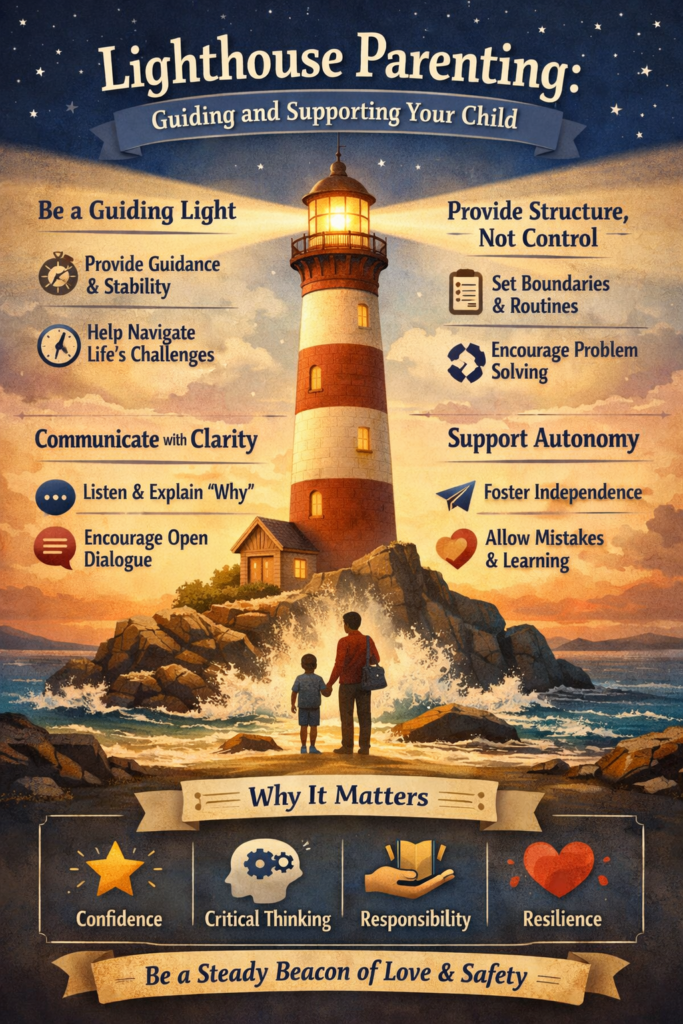
That’s why so many of us are moving toward Lighthouse Parenting. Think about it: A lighthouse doesn’t jump into the water to save the ship. It stands firm on the rocks and beams its light so the ship can find its own way. You are the stable, warm presence. You set the boundaries (the light), but you let your child navigate their own waves. It’s the antidote to that “always-on” empathy that’s been draining us dry.
📣 Loved what you read? Want to go deeper into conscious parenting? ✨ The Power of Manifestation in Parenting is now available — A soulful guide packed with real-life tools like affirmations, energy shifts, and sleep talk that I personally use with my son, Hitarth. 💛 Start your journey toward calmer, connected parenting today. 🎉 Launch Offer: Only ₹99 (limited-time price!) 📲 Instant download. No waiting. 👉 Grab your copy now!.
From ‘Aesthetic’ to ‘Authentic’: Moving Beyond the Beige Mom Era
For years, social media convinced us that a “calm” home meant neutral colors, wooden toys, and a strictly low-stim environment. But let’s be honest: for a Gen Z mom in 2026, keeping a house “beige” felt like just another unpaid chore.
According to the latest Pinterest Predicts 2026 report, we are officially entering the “Fun Haus” era. We’re seeing a massive spike in searches for “circus interiors” and bold, saturated colors like terracotta and sage green.
This isn’t just about home decor; it’s a mental health choice. By letting go of the pressure to maintain a curated, ‘Millennial Gray’ aesthetic, we are reclaiming our homes as lived-in, joyful spaces. In 2026, we are prioritizing connection over perfection. We’re trading the “sad beige” guilt for “authentic chaos”—because a house with color and a little mess is a house where memories are actually being made.
The 7 Core Gen Z Moms Parenting Struggles in 2026
1. Algorithm Anxiety & The “Sharenting” Dilemma
In 2026, Algorithm Anxiety is the specific pressure parents feel to curate their child’s life for digital engagement while fearing the long-term consequences. Gen Z parents face a unique “sharenting” conflict: the desire to document milestones vs. the ethical need for child privacy.
Unlike Millennial “mommyloggers,” Gen Z is leading a Privacy-First Pivot. You’ll notice the rise of “faceless” parenting accounts and “emoji-blurring” as a standard in 2026. This is a direct response to the struggle of wanting a digital village without compromising a child’s future “right to be forgotten.”
2. The Gentle Parenting Burnout & Nervous System Fatigue
Gentle parenting burnout is reaching a breaking point in 2026. It is no longer just “being tired”; it is Nervous System Fatigue caused by the constant demand for “perfect emotional regulation.”
Gen Z moms often feel they must validate every tantrum without ever showing their own frustration. This “always-on” empathy often leads to a depleted battery and a crushing sense of failure when they inevitably react with human emotion. In 2026, the struggle is learning that you cannot regulate a child if your own nervous system is on fire.
3. Digital Native Guilt & The Screen Time Paradox
Being tech-savvy is a double-edged sword. Since we grew up with the internet, we know exactly how addictive those algorithms are—and that’s where the “Screen Time Paradox” kicks in. We feel like hypocrites every time we use a tablet as a “digital babysitter” just so we can finish a work call or take a breath.
In 2026, the struggle has shifted from “how many minutes” to “how much value.” We are moving toward Interactive Co-Viewing (watching with the child) to ease the guilt of using a tablet as a “digital babysitter” during work-from-home hours. Yet, the underlying anxiety of raising “iPad kids” remains a primary mental health hurdle.
4. The “Village” Trade-off: Sanity vs. Support
While Western blogs talk about “Boomerang Parenting,” our reality in India is more of a Calculated Trade-off. With the chaos of urban life in 2026, many of us find ourselves staying in (or moving closer to) joint family setups. It’s not always a financial crunch; sometimes it’s a desperate need for a “village” we can trust while we manage careers and life.
But here’s where the real Gen Z moms parenting struggle kicks in: The Autonomy Tax. You get the help with the baby, but you pay for it with your sanity. You’re trying to be a “Lighthouse” and set boundaries, but your mother-in-law is in the other room thinking you’re being too soft. You end up “co-parenting” with an entire household, and that constant need to explain or defend your “conscious” choices to your elders is emotionally draining. We want the support, but we’re starving for the space to just parent our way.
5. Information Overload: AI-Paralysis & TikTok “Experts”
In 2026, the struggle isn’t a lack of info—it’s AI-Paralysis. Parents are now paralyzed by conflicting advice from AI chatbots, Instagram “certified” coaches, and viral parenting hacks.
Instead of trusting their gut, many moms consult an AI for everything from fever advice to sleep training. This constant “second-guessing” via search engines erodes a mother’s confidence in her natural instincts, leading to a state of “Research-Induced Anxiety.”
6. The Ghost Village Syndrome
The Ghost Village Syndrome is the loneliest struggle of 2026. It describes having thousands of “followers” or “friends” online but zero physical support in the real world.
While Gen Z moms have the most “connected” parenting experience in history, they report the highest levels of isolation. In 2026, the “village” has become a spectator sport; people “like” your post about a sleepless night, but they aren’t there to hold the baby while you eat a warm meal.
7. The Cycle-Breaking Tightrope in Desi Households
Breaking generational cycles in an Indian context is an emotional tightrope walk. It means choosing validation over the traditional “shaming” or “fear-based” discipline used in many desi households.
For an Indian Gen Z mom, this is a Double Burden: you are healing your own childhood triggers while simultaneously defending your parenting choices to your parents and in-laws. It is an emotionally taxing journey to prove that “gentle” does not mean “weak” in a culture that traditionally values absolute authority.
Lighthouse Parenting: The 2026 Solution to Gen Z Burnout
If you feel like you’re drowning in the expectations of “Gentle Parenting,” consider Lighthouse Parenting your life raft. This isn’t just a buzzword; it’s a style pioneered by Dr. Kenneth Ginsburg that is gaining massive traction in 2026 because it finally gives us permission to have balance.
Think of a lighthouse. It doesn’t jump into the ocean to try and steer the ship, right? It doesn’t get tossed around by every wave. It stands firm on the rocks, beaming a steady, reliable light so the ship can find its own way home.
To understand why this is the 2026 “Gold Standard,” let’s look at the alternatives:
-
The Helicopter Parent: You’re hovering. You’re micromanaging every wave to make sure they never crash. The problem? Your child never learns how to sail their own ship.
-
The Gentle Parent (The Burnout Version): You’re so focused on validating their emotional waves that you forget to stay on the “rocks” yourself. You get pulled into the water with them, and eventually, you drown in exhaustion.
-
The Lighthouse Parent (Our Goal): You provide that “safe harbor” of unconditional love, but you actually trust your child to handle age-appropriate challenges. You are the stable, guiding presence. You set high expectations and firm boundaries (the light), but you let them do the steering.
This shift is the direct antidote to the Gen Z moms parenting struggles we are all feeling. It allows us to be “conscious” parents without sacrificing our own mental health.
Related read: Millennial Moms Don’t Have It All. They Just Do It All.
Practical Tools for the Modern Indian Mom
If one more person tells me to “journal” while my toddler is painting the walls with turmeric, I might scream. Here’s what actually works in a busy Indian home:
1. The “Priority-Block” Method for Joint Families
Don’t try to “manage time”; manage your energy. Use Time-Blocking to communicate with your family.
-
The Strategy: Set a “Deep Focus Block” (e.g., 2:00 PM – 3:00 PM) when the baby naps. Tell your in-laws or partner, “This is my ‘Battery Recharge’ hour.” By giving it a name and a set time, you create a boundary that others can respect.
2. 2026 Indian Tech Stack for Moms
Instead of getting lost in endless scrolling, use these Indian, mom-friendly digital spaces to save mental energy and feel supported:
-
BabyChakra & ParentCircle: Great for finding doctor-verified advice that understands Indian diets and cultural nuances.
-
Healofy: Excellent for connecting with other Indian moms in your regional language to find your “Digital Village.”
-
Momyhood: A safe, judgment-free space where real moms share real stories—from pregnancy and parenting to women’s health and emotional well-being.
Less pressure. More relatability. Content that feels like “someone understands my life.”
3. The “Micro-Self-Care” Hack
If you can’t get an hour, take 60 seconds. In 2026, “Mindful Breathing” apps (like iMumz) are becoming a staple for Indian moms to lower cortisol levels between diaper changes and kitchen duties.
Frequently Asked Questions
What is Lighthouse Parenting?
Lighthouse Parenting is an evidence-based approach developed by Dr. Kenneth Ginsburg that balances unconditional love with firm boundaries. Like a lighthouse, parents provide steady guidance without hovering or controlling their child’s every move.
Why do Gen Z moms feel more overwhelmed than millennials?
Gen Z mothers face unique pressures including information overload from social media, ethical concerns about “sharenting,” financial challenges despite being digital natives, and the burden of conscious parenting while breaking generational patterns.
What is the difference between gentle parenting and lighthouse parenting?
Gentle parenting focuses heavily on validating children’s emotions, which can lead to burnout. Lighthouse parenting balances warmth with structure—offering both empathy AND firm boundaries to prevent parental exhaustion.
How can Indian Gen Z moms handle joint family pressures?
Use the “Priority-Block” method to communicate boundaries with in-laws, connect with other conscious parents through apps like Healofy, and remember that you can honor elders while choosing different parenting methods.
Conclusion: Moving Beyond the Struggle
Parenting in 2026 is an extreme sport, and you are doing it with more awareness than any generation before you. While Gen Z moms parenting struggles are real and heavy, they are also the birth pains of a more authentic, connected way of raising humans. You aren’t failing; you are pioneering a new path.
Remember, your child doesn’t need a mother who is a perfect “gentle parenting” robot. They need a mother who is a “Lighthouse”—stable, present, and human.
Let’s Talk! Which of these struggles hit home the most for you? Is it the “Ghost Village” or the pressure to be a “Pinterest Mom” in a desi household? Drop a comment below!
While Gen Z Moms parenting struggles are real, you don’t have to face them alone. Let’s build our village together.
Your comments and shares do more than just support our blog—they uplift the amazing moms who share their stories here. Please scroll down to the end of the page to leave your thoughts, and use the buttons just below this line to share. Your support makes a big difference!