
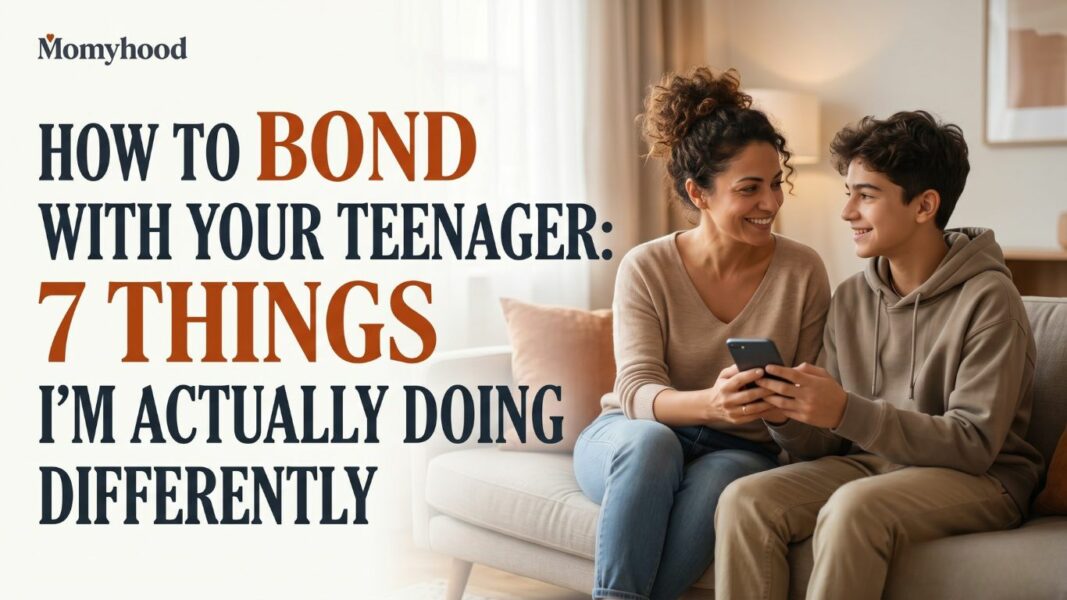
A few months back, my 13-year-old started shutting the door. Not in an angry way — just… a normal, this-is-my-space way. And I remember standing outside it the first time thinking, okay, this is the start of something. The cute “mumma tell me a story” years are over, and a whole new phase has begun, one where I have to earn the conversations I used to get for free. So I started paying real attention to how to bond with your teenager in a way that doesn’t feel forced, and here’s what I’ve actually learned.
Why I stopped waiting for “the right moment” to talk
I used to think big conversations needed a big moment — sit down, “beta we need to talk,” the works. That never worked. What I’ve realised instead is that connection with a teenager isn’t one conversation, it’s a hundred tiny ones. The five minutes in the car. The ten minutes before lights off. Those add up to something a single “heart-to-heart” never could.
And honestly, the stakes feel higher now than they did when he was little. A kid who feels close to you doesn’t need to hide things from you — and figuring out how to bond with your teenager, for me, really started with accepting that.
1. I dropped “how was school” completely
1I’ll be honest — for the longest time “how was school” was my go-to, and I’d get a flat “fine” every single time. One word. Conversation over before it started. It took me embarrassingly long to realise the question itself was the problem.
Now I ask something specific, usually during our 10-minute drive back from tuition, because that’s when he’s a captive audience and somehow more chatty than at home:
It sounds like a small shift but it isn’t. Funny, specific, slightly silly questions get real answers. Generic ones get a wall. And I had to make a rule for myself too — phone goes in my bag, not face-down on the seat, actually away. He noticed before I even said anything.
2. I had to physically stop myself from jumping in to fix things
2This one I’m still working on, not gonna lie. He came home upset one day because his best friend had ditched him for another group at lunch, and my first instinct — genuinely, within two seconds — was to start telling him what he should do about it.
📣 Loved what you read? Want to go deeper into conscious parenting? ✨ The Power of Manifestation in Parenting is now available — A soulful guide packed with real-life tools like affirmations, energy shifts, and sleep talk that I personally use with my son, Hitarth. 💛 Start your journey toward calmer, connected parenting today. 🎉 Launch Offer: Only ₹99 (limited-time price!) 📲 Instant download. No waiting. 👉 Grab your copy now!.
I caught myself and tried something different instead.
What I said instead: “Ugh, that sounds really crappy. Do you want to vent about it, or do you want my advice?”
He said “just vent” — and honestly, that surprised me. But that one question changed the whole conversation. He kept talking for another ten minutes without me saying much at all. I’ve noticed now that the more I jump straight to solving, the faster the conversation shuts down. Just saying “that does sound hard” first, before anything else, gets me so much further than I expected.
3. I let him be the boss of one thing a week
I used to plan every single bit of our together-time — what we’d cook, what we’d watch, where we’d go. Somewhere along the way I realised he was just… going along with it, not really engaged. So I flipped it. Now one thing a week is fully his call, no input from me.
Letting him lead turned out to be one of the most effective ways I’ve found for how to bond with your teenager without it feeling forced.
- Sunday is his “cooking experiment” — he picked a Maggi-fusion recipe off some reel and I just let him mess up the kitchen
- Friday night movie is 100% his pick now, even when it’s something I don’t enjoy, and I genuinely don’t comment
- He’s been teaching me how to edit reels on my phone, and honestly I’m terrible at it and he loves that
- Sometimes it’s just a scooter ride to the chaat wala near our house, his idea, no real agenda
4. I noticed my “choices” weren’t really choices
4I caught myself doing this constantly — “you can do homework now or after dinner” — and thinking I was being the cool, flexible parent. I wasn’t. That’s not a choice, that’s control dressed up nicely, and at 13 he could see right through it faster than I could.
So I started actually handing over things that are genuinely his to decide — how he keeps his room, what he wears to school events (within reason), how he plans his own study hour. The first week felt uncomfortable, not gonna lie.
What I didn’t expect was how it changed the bigger stuff. The week I backed off on the small things, he didn’t push back nearly as hard on the screen-time rule, which I’m not budging on. I genuinely think it’s connected — once he felt some real control, he stopped fighting me on everything.
And the closed door I mentioned at the start? I’ve stopped reading into it as something to worry about. He’s figuring out who he is in there, not hiding something terrible. I focus instead on keeping our home the kind of place his friends actually want to hang out at — that tells me more than checking his phone ever would.
5. I started admitting when I’m wrong, out loud
5I grew up in a house where parents were never wrong, full stop. “Hum bade hain, hum sahi hain” was just understood. I’m actively trying to unlearn that, because I don’t think it’s serving him, or me.
A couple weeks ago I snapped at him over something small because I was stressed about something completely unrelated. Old me would’ve just moved on like nothing happened. Instead I went back to him later.
I genuinely thought this would make him respect me less. It’s done the opposite. He’s started doing it back to me too — apologising first, without me asking — which never used to happen. I’m also trying to say my feelings out loud instead of just being silently annoyed: “I’m feeling really frustrated right now, give me five minutes before we talk about this.” He’s watching how I handle my own mess, way more closely than he’s listening to anything I tell him to do.
Related read: Parenting a Teenager: How One Misunderstanding Taught Us a Powerful Lesson
6. I learned my reaction in the first 5 seconds matters most
6This is the one I think about the most, honestly, because we haven’t hit the really big stuff yet — but smaller versions keep happening. He told me once that a kid in his class was being made fun of pretty badly in their group chat, and that he hadn’t said anything to stop it.
My stomach dropped. I wanted to react. But I’d read somewhere that your first reaction decides whether your teen ever tells you the next thing, so I made myself just breathe before saying anything.
I’ve also noticed he tells me harder things more easily when we’re not facing each other — in the car, or walking, side by side. Sit-down “beta we need to talk” conversations make him clam up immediately. So now if something feels heavy, I wait for a car ride instead of pulling him aside.
I didn’t expect this, but learning how to bond with your teenager turned out to be less about what I say and more about where I choose to say it.
7. I banned myself from comparing him to anyone
7This was the hardest habit to break, not gonna lie, because comparison is basically baked into how a lot of us were raised. “Sharma ji ka beta” jokes aside, I actually used to do versions of this without realising — “your cousin finished her project already” type comments, said casually, meant as motivation.
I stopped completely after I noticed how his face changed every time I said something like that. Now I try to catch and praise the effort itself, not just the result, and never against anyone else’s yardstick.
What I say now: “I noticed you kept redoing that science model even after it collapsed twice. That’s real persistence.”
And “why can’t you be like ___” is a sentence I’ve fully retired from my vocabulary. I genuinely believe it tells a kid that your love comes with a comparison attached, and that’s not something I want him carrying around. Now we just talk about how he’s doing against where he was last month — that’s it, that’s the only comparison allowed in our house.
What’s Actually Working — My Honest Take on How to Bond with Your Teenager
| The shift | What changed at home |
|---|---|
| Dropped “how was school” | He actually talks in the car now, not one-word answers |
| Asking “vent or advice?” | He shares more before I even open my mouth |
| He leads one activity a week | He shows me things unprompted now |
| Handing over real choices | Less pushback on the rules I’m not budging on |
| Admitting when I’m wrong | He’s started apologising first too |
| Calm face, first 5 seconds | He brings me harder things, not just small stuff |
| No more comparisons | Way less tension around marks and effort |
Also read: Teens feel less secure when parents are constantly on their phones
Questions I’ve actually asked myself along the way
What’s the fastest way to bond with your teenager?
Honestly, for us it wasn’t one big thing — it was dropping “how was school” and asking something specific instead. That tiny shift opened up everything else.
What if my teenager has already pulled away a lot?
I don’t think it’s ever too late, honestly. I remind myself it’s not about one big conversation — it’s tiny low-pressure moments, stacked up over weeks. Even just sitting in comfortable silence in the car counts before you push for actual talking.
How much freedom is too much, too soon?
I’m still figuring this out, honestly. What’s worked for us is moving slowly — a little more freedom each time he shows he can handle it, rather than handing it all over at once or holding on too tight.
What if I lose my temper anyway?
I do, more than I’d like to admit. What I’ve learned matters more than not losing it at all is going back afterward — “I’m sorry I yelled, that wasn’t fair to you” — every single time.
If you’re still figuring out how to bond with your teenager, just know — five honest minutes today does more than one perfect conversation someday.
Your comments and shares do more than just support our blog—they uplift the amazing moms who share their stories here. Please scroll down to the end of the page to leave your thoughts, and use the buttons just below this line to share. Your support makes a big difference!