
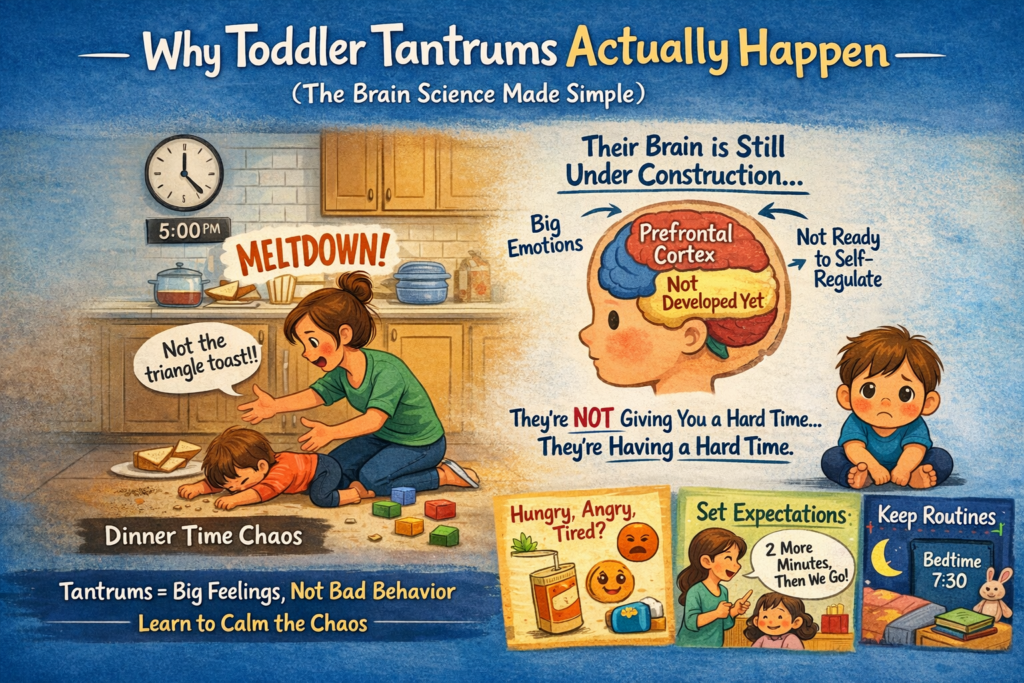
Look, I’ve been there. It’s 5:00 PM, you’re trying to get dinner on the table, and suddenly your toddler is face-down on the kitchen floor because you cut their toast into triangles instead of squares. In those moments, my brain usually goes into “emergency mode.” I used to think my only job was to stop the screaming as fast as possible. But after a few years of trial, error, and a lot of deep breaths, I learned how to handle toddler tantrums in a completely different way. I realized something life-changing: A tantrum isn’t a behavior problem; it’s a big feeling that hasn’t found a home yet.
Why Toddler Tantrums Actually Happen (The Brain Science Made Simple)
Here’s the 5-second neuroscience that changed how I see tantrums: Your toddler’s brain literally isn’t finished being built yet. The part that controls emotions and problem-solving (the prefrontal cortex, if you want to get technical) won’t be fully developed until they’re in their mid-twenties.
So when your two-year-old loses it over the “wrong” colored cup, it’s not manipulation or bad behavior—it’s their developing brain getting completely overwhelmed by a feeling they don’t have the wiring to manage yet. They’re not giving you a hard time; they’re having a hard time.
Toddler tantrums typically peak between ages 1 and 3, and usually start tapering off around age 4 as kids develop better language skills and emotional regulation. But in those early years? Their feelings are HUGE and their ability to cope is still tiny.
Understanding this completely shifted my response from “How do I make this stop?” to “How can I handle toddler tantrums in a way that actually helps my child learn?”
Related read: How to deal with toddler tantrums — and why they happen in the first place
How to Handle Toddler Tantrums Before They Start (Prevention Tips)
I learned the hard way that an ounce of prevention really is worth a pound of cure when it comes to handling toddler tantrums. Here are the tantrum triggers I now watch for like a hawk:
📣 Loved what you read? Want to go deeper into conscious parenting? ✨ The Power of Manifestation in Parenting is now available — A soulful guide packed with real-life tools like affirmations, energy shifts, and sleep talk that I personally use with my son, Hitarth. 💛 Start your journey toward calmer, connected parenting today. 🎉 Launch Offer: Only ₹99 (limited-time price!) 📲 Instant download. No waiting. 👉 Grab your copy now!.
The Big Three: Hungry, Angry, Tired
This sounds so basic, but I can’t tell you how many meltdowns I’ve prevented just by keeping crackers in my purse and protecting naptime like it’s a sacred ritual. When my kids are hungry or overtired, their fuse gets about an inch long. I started planning errands around mealtimes and naps, and honestly? Game-changer.
Set Expectations Before Transitions
I used to just announce, “Time to leave the park!” and then wonder why my daughter would tantrum. Now I give warnings: “We’re leaving in 5 minutes. Then 2 minutes. Okay, one more turn on the slide, then we’re going to the car.” It doesn’t always work, but it helps way more often than not.
Keep Routines Consistent
Kids thrive on predictability. When bedtime is always at 7:30, breakfast is always followed by getting dressed, and we always read two books before bed, my kids feel more secure. And secure kids tantrum less. I’m not saying you need to be a robot, but having a general rhythm to your day makes a real difference.
Watch for Common Tantrum Triggers
After a few months of tantrum detective work, I figured out my daughter’s patterns:
- Transitions (leaving fun places, stopping activities)
- Frustration with tasks (puzzles, zippers, anything “tricky”)
- Feeling embarrassed or corrected in front of others
- Overstimulation (too many people, loud environments)
Once I knew her triggers, I could either avoid them when possible or give her extra support when they were unavoidable.
My 3 Go-To Strategies to Handle Toddler Tantrums When They Happen Anyway
Here’s the thing: even with all the prevention in the world, toddler tantrums still happen. Because toddlers are learning, and learning is messy. I started viewing these “disasters” as tiny classrooms. Here are the three solutions I use in my own home that helped me learn how to handle toddler tantrums—not by stopping the “shush-ing,” but by teaching my kids how to handle life.
1. The “Feelings Check-In” (Teaching Emotional Intelligence)
The first time I tried this, I felt a little silly. My daughter was sobbing because she couldn’t put her own shoes on. My old move was to just grab the shoes and do it for her. Now? I sit on the floor at her level.
What I do: I say, “It looks like you’re feeling frustrated because those shoes are tricky. It’s okay to be frustrated.”
The Life Skill: Emotional Regulation. By naming the feeling, I’m giving her the vocabulary to tell me what’s wrong next time instead of just screaming.
The Result: She usually stops crying sooner because she feels “heard.” She learns that feelings aren’t scary; they’re just things we name and move through.
I stay with her during the tantrum—I don’t walk away or ignore it. Research shows that kids need us present during big emotions to learn how to regulate them. Ignoring tantrums doesn’t teach coping skills; it just teaches kids that they’re alone with overwhelming feelings.
2. The “Helper Mission” (Teaching Problem Solving)
Messes are the biggest trigger for tantrums in my house. A spilled juice box used to lead to a total meltdown (for both of us!).
What I do: Instead of sighing and grabbing the paper towels myself, I make it a team mission. “Oh no, the juice escaped! We need the Cleanup Crew. Can you grab the blue towel while I move the chair?”
The Life Skill: Personal Responsibility. It shifts the focus from “I messed up” to “I can fix this.”
The Result: It turns a moment of shame into a moment of confidence. My kids are learning that mistakes happen, but we have the power to solve them.
3. The “Two-Choice Trick” (Teaching Decision Making)
Most of my toddler’s tantrums came from feeling like she had zero control over her life. Imagine being told when to eat, sleep, and wear pants all day! I’d be cranky too.
What I do:When I see a “power struggle” tantrum brewing, I offer two specific choices. “It’s time to leave the park. Do you want to hop to the car like a frog or stomp like a dinosaur?”
The Life Skill: Critical Thinking and Autonomy. She’s learning how to make decisions within boundaries.
The Result: She feels like she has a “say” in her day. The tantrum usually evaporates because her brain switches from “fighting” to “choosing.”
Also read: How Mindful Parenting Helps Me Handle Tantrums and Build Stronger Bonds with My Kids
How to Handle Toddler Tantrums When They Get Physical (And What I Do About It)
Sometimes toddler tantrums escalate into hitting, kicking, throwing things, or even head-banging. This is the scariest part of learning how to handle toddler tantrums, and I want you to know: you’re not alone if this happens.
Here’s what I do:
For hitting/kicking: I calmly get down at her level, gently hold her hands if needed, and say firmly but kindly: “I won’t let you hit. Hitting hurts. You’re upset, and I’m here to keep everyone safe.”
For throwing: I move her away from anything she could throw or hurt herself with. “I see you’re angry. I’m not going to let you throw toys because someone could get hurt. You can stomp your feet or squeeze this pillow instead.”
For head-banging or self-harm: This one terrified me the first time it happened. I physically get between my child and the floor/wall. I’ll sit behind her and gently hold her or place my hand between her head and the hard surface. I say calmly: “I won’t let you hurt yourself. I’m keeping you safe. I’m right here.”
The key is to stay calm (even when your heart is racing) and keep everyone safe without shaming your child. She’s not being “bad”—she’s overwhelmed and needs you to be her safety net.
When to Worry About Toddler Tantrums
Most toddler tantrums are completely normal, but here are the signs I learned to watch for that might mean it’s time to talk to your pediatrician:
- Tantrums that consistently last longer than 15-20 minutes
- Tantrums that get worse or more frequent after age 4
- Your child regularly hurts themselves or others during tantrums
- Your child holds their breath until they faint
- You feel completely overwhelmed and don’t know how to cope
I’m not a doctor or therapist, so I can’t diagnose anything—but I can tell you that reaching out for help isn’t a failure. It’s taking care of your kid and yourself. I talked to our pediatrician when my daughter’s tantrums seemed especially intense, and she gave me some reassurance and a few extra tools that really helped.
My “Mama-to-Mama” Secret…
The biggest thing I learned about how to handle toddler tantrums? You can’t teach a child to be calm if you aren’t calm. If I’m hovering at a Level 10 of stress, they’re going to stay there too. Sometimes, the “learning opportunity” is actually for me—learning to take a five-second breath before I react.
I still lose my cool sometimes. I still have moments where I want to run out the front door and keep running. But on most days now, I can see toddler tantrums for what they are: my child’s brain doing exactly what it’s supposed to be doing at this age. And I can be the calm, steady guide they need while they’re learning to navigate their big, overwhelming feelings.
We’re all growing together, one spilled juice box at a time.
Your turn: What’s your toddler’s most ridiculous tantrum trigger? Drop it in the comments—because sometimes we just need to laugh about the absurdity of parenting tiny humans who lose it over toast shapes. 💙
Your comments and shares do more than just support our blog—they uplift the amazing moms who share their stories here. Please scroll down to the end of the page to leave your thoughts, and use the buttons just below this line to share. Your support makes a big difference!