
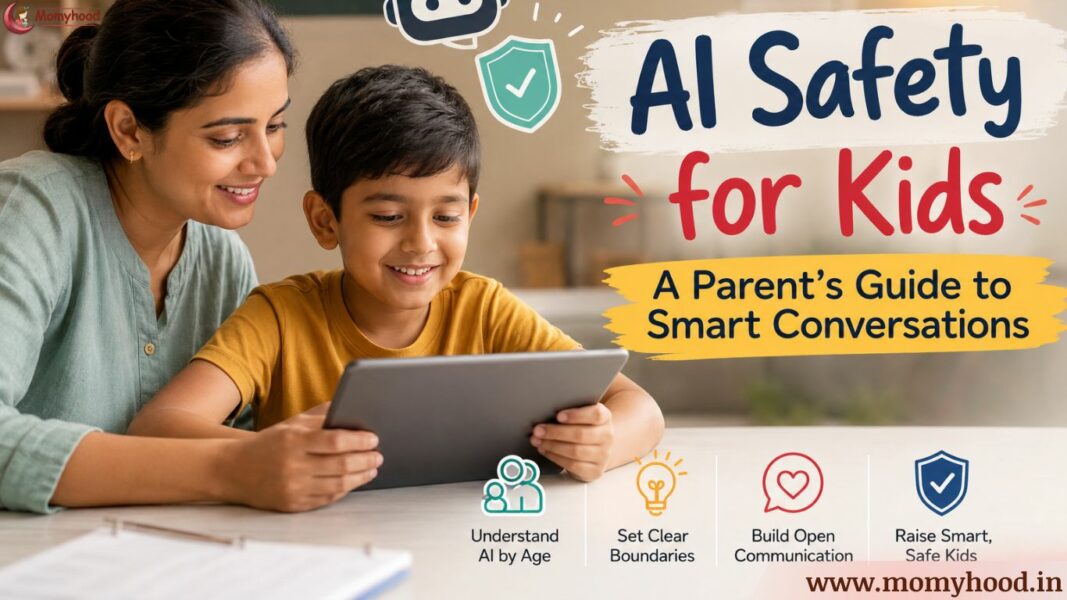
Last week, Aryan was doing his homework and, without asking me, asked the AI helper on his school iPad, “Why do we celebrate Diwali?” I was glad he got a quick answer — but for a second, my heart skipped a beat too. Was the answer even correct? What else could he have clicked on that wasn’t meant for him? That was the moment it hit me: AI safety for kids isn’t just a buzzword anymore — it’s a part of everyday parenting now, whether we’re ready for it or not.
Our children weren’t born into an AI-free world, but they’re growing up in one where AI is already woven into their homework, their games, and even their YouTube recommendations. In this post, I want to share how I’ve been navigating AI safety at home, the mistakes I made along the way, and how Aryan and I now talk about this topic — without scaring him, and without becoming an overprotective parent either.
What AI Safety for Kids Actually Means
When I first heard the term “AI safety,” I assumed it just meant installing a parental control app. But the more I understood it, the more I realised it isn’t only about settings — it’s about conversations. It’s about understanding how children perceive AI: do they see it as a friend? Do they believe everything it tells them? Could they end up sharing personal details without realising where that information goes?
When Aryan was 6, we got Alexa at home purely to play songs. But slowly, I noticed he started asking it questions like it was someone who actually knew him — “Alexa, do you know who my best friend is?” That was my first real signal that for children, the line between AI and reality isn’t as clear as we assume it is.
What I’ve learned as a mom: Children need to understand that AI is a tool, not a person — no matter how natural it sounds when it talks back.
Also read: 7 Real Gen Z Parenting Struggles in 2026: Why ‘Gentle Parenting’ is Failing
How AI Conversations Change by Age
Every age brings a different relationship with AI, and this is something I’ve learned through my own observation, not just from articles:
📣 Loved what you read? Want to go deeper into conscious parenting? ✨ The Power of Manifestation in Parenting is now available — A soulful guide packed with real-life tools like affirmations, energy shifts, and sleep talk that I personally use with my son, Hitarth. 💛 Start your journey toward calmer, connected parenting today. 🎉 Launch Offer: Only ₹99 (limited-time price!) 📲 Instant download. No waiting. 👉 Grab your copy now!.
- Ages 3-7: At this age, kids often believe AI is real — like a magical friend who knows everything. When Aryan was 5, he used to say “please” and “thank you” to Alexa, exactly like he would to a person.
- Ages 7-11: This is where curiosity grows — kids start using AI for games, search, and school projects (like Aryan’s Diwali question). This is the perfect age to introduce simple rules: AI can be wrong, and it’s okay to double-check with a parent or teacher.
- Ages 11-14: Pre-teens begin using AI-powered apps more independently — for social media filters, content recommendations, even chatbots. This age needs conversations about critical thinking, not just supervision.
- Ages 14-18: Teens use AI tools for schoolwork, creativity, and sometimes emotional support. Here, the focus shifts to responsible use, online reputation, and recognising when AI-generated content might be misleading.
The Homework Dilemma Every Parent Faces
I’ll be honest — the hardest part for me hasn’t been setting up parental controls. It’s been figuring out where to draw the line between “AI is helping my child learn” and “AI is doing my child’s thinking for him.”
A few months back, Aryan came to me proudly with a “story” he’d written for school, and something about the polish of it felt off. When I asked him about it, he admitted he had asked an AI app to help him “make it sound better.” He wasn’t lying or hiding it — he genuinely didn’t see anything wrong with it. That conversation taught me something important: kids don’t inherently know where the line is unless we draw it together with them.
Since then, we’ve made a simple family rule — AI can help Aryan understand a topic or brainstorm ideas, but the actual writing, drawing, or answering has to be his own. It’s not about restricting technology; it’s about protecting his own thinking process while he’s still building it.
Signs Your Child Might Be Over-Relying on AI
- They ask AI tools questions they used to ask you first
- They accept AI answers without questioning them, even when something sounds off
- Their schoolwork suddenly sounds more advanced or “adult” than usual
- They talk to AI chatbots the way they’d talk to a close friend
How I Talk to Aryan About AI Safety Without Scaring Him
I never wanted our conversations about AI to feel like a lecture or a list of “don’ts.” Instead, I try to make it feel like we’re figuring it out together — because honestly, most days, we are.
One thing that worked well for us was treating AI like a “new kid in class” — someone who seems smart and friendly, but whom you still get to know slowly, and don’t trust with everything right away. Aryan understood that comparison instantly, because it’s something he’s actually experienced at school.
We also do a simple weekly check-in — just five minutes where I ask him what new app or AI tool he came across that week, and what it does. Not as an interrogation, but as genuine curiosity. More often than not, he ends up teaching me something new, and that keeps him talking to me instead of hiding things.
A simple rule we follow at home: If an AI tool ever makes Aryan feel confused, upset, or like it “knows” something private about him, the first step is always to come tell me — no exceptions, no getting in trouble.
Related read: ‘It’s deeply disturbing.’ What a new report says about risks Google’s AI search features pose to kids
Practical AI Safety Habits We’ve Built at Home
- We use AI tools together first before Aryan uses them alone
- We talk openly about how AI can be wrong or make things up
- We’ve set clear rules about not sharing personal information with any chatbot or AI app
- We celebrate honesty — if he tells us he used AI for something, we don’t punish, we discuss
- We keep reminding him that AI doesn’t replace real friends, real learning, or real conversations with us
AI isn’t going away from our children’s lives — if anything, it’s only going to become a bigger part of how they learn, play, and connect. As parents, our job isn’t to keep AI away from our kids completely; it’s to walk alongside them as they learn to use it wisely. For me, that journey started with one simple question from Aryan about Diwali, and it’s turned into an ongoing conversation in our home — one I’m grateful we’re having early, and one I’d encourage every parent to start today, whatever age your child is.
Your comments and shares do more than just support our blog—they uplift the amazing moms who share their stories here. Please scroll down to the end of the page to leave your thoughts, and use the buttons just below this line to share. Your support makes a big difference!