
For almost a year, my mornings sounded like a broken record. “Brush your teeth.” “Where’s your uniform.” “Five more minutes, then breakfast.” I was saying the same ten instructions every single day, and Aryan was tuning out every single one. What finally broke that cycle wasn’t stricter rules — it was a simple daily routine chart for kids that Aryan helped design himself, taped to our fridge, where he could see exactly what came next without me having to say it out loud.
Key Takeaways
- A daily routine chart for kids works best when the child helps design it, not when a parent hands them a finished schedule.
- Pictures or icons work better than written words for children who aren’t yet strong readers.
- Morning and evening routines should be kept separate and visually distinct, so kids don’t get confused about which list applies when.
- A chart reduces daily nagging because the child checks the chart instead of waiting to be told.
- Built-in flexibility — a “free choice” slot — makes kids more willing to follow the rest of the chart.
- Reviewing and adjusting the chart weekly keeps it useful instead of something the child eventually ignores.
If you’re a parent constantly repeating the same instructions every morning and every night, you’re not doing anything wrong — most kids genuinely need a visual cue, not just a verbal one, to build a habit. A chart doesn’t replace parenting. It just gives your child a way to manage part of their day without you standing over them.
Why Does a Daily Routine Chart for Kids Actually Work?
A routine chart works because it turns an abstract expectation into something your child can see and check off. When I only told Aryan what to do, he had to remember it, understand it, and act on it, all while I was usually asking him to stop something else he was doing. When the chart did the telling, he just had to look and follow.
There’s also something about a chart being visible and shared that makes it feel less like a rule and more like a plan. A spoken instruction can feel like a command. A chart on the wall feels like information — and kids respond very differently to the two.
How Do You Actually Build One Kids Will Use?
The single biggest mistake I made the first time was designing the chart myself and just presenting it to Aryan as finished. He looked at it for two days and then ignored it completely. The second attempt worked because I sat down with him and built it together.
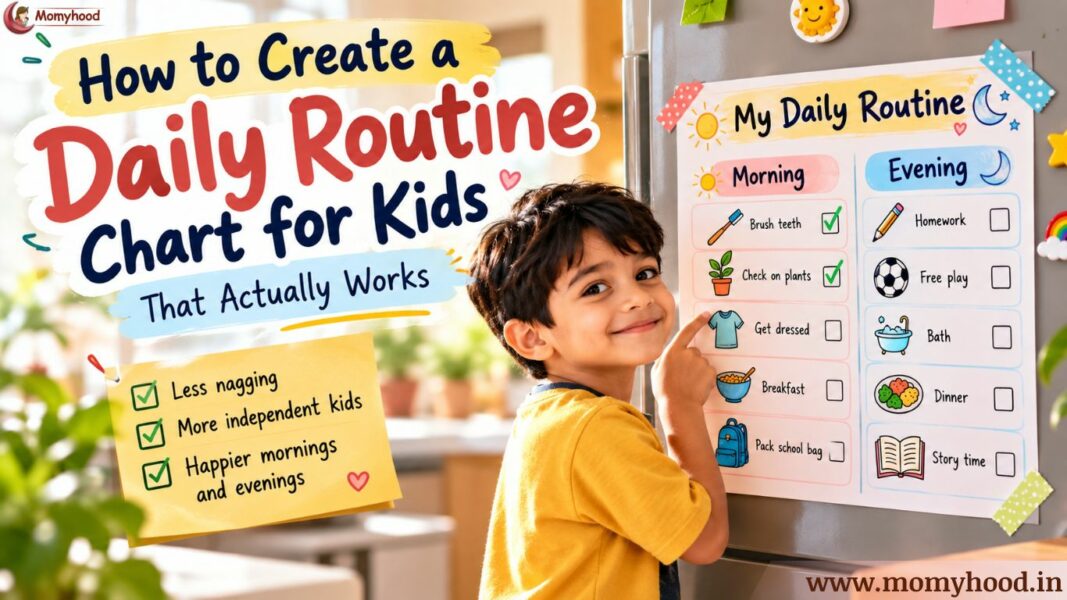
We used a simple grid — mornings down one column, evenings down another — and let him draw small icons next to each task instead of writing full words. A toothbrush doodle for brushing teeth, a plate for breakfast, a backpack for getting his bag ready. Even kids who read well tend to respond faster to a picture they can glance at than a sentence they have to process.
| Time of Day | Task | Icon Idea |
|---|---|---|
| Morning | Brush teeth | Toothbrush |
| Morning | Check on plants | Small plant |
| Morning | Get dressed | Shirt |
| Morning | Pack school bag | Backpack |
| Evening | Homework | Pencil |
| Evening | Free play | Ball |
| Evening | Bath | Bathtub |
| Evening | Story time | Book |
We kept mornings and evenings visually separate, with a clear line down the middle of the chart, because Aryan kept mixing up the two lists in the first draft. Once the split was obvious, that confusion disappeared completely.
📣 Loved what you read? Want to go deeper into conscious parenting? ✨ The Power of Manifestation in Parenting is now available — A soulful guide packed with real-life tools like affirmations, energy shifts, and sleep talk that I personally use with my son, Hitarth. 💛 Start your journey toward calmer, connected parenting today. 🎉 Launch Offer: Only ₹99 (limited-time price!) 📲 Instant download. No waiting. 👉 Grab your copy now!.
Also read: The Kids’ Morning Routine That Makes School Days So Much Easier
What Keeps a Routine Chart From Being Ignored After a Week?
Most routine charts I’d seen other parents try seemed to fail within two weeks, and I understood why the moment I tried a strict one myself — there was no room in it for Aryan to have any choice at all. So the second version included one small, deliberate gap: a slot labeled “free choice,” where he picks anything he wants within a short time window.
We also review the chart together once a week, usually on Sunday evening, and change anything that’s stopped working. Some weeks that means moving “check on plants” earlier because he was rushing through it. Other weeks it’s swapping in a new evening activity because he’s lost interest in the old one. Treating the chart as something we update, rather than something fixed forever, is part of why it’s outlasted every other routine we’ve tried.
This same weekly check-in habit is part of what’s helped Aryan grow into a more emotionally intelligent child generally — being asked what’s working and what isn’t teaches him to notice his own patterns, not just follow instructions.
What Would I Tell a Parent Starting From Scratch?
Don’t design the chart alone at night after the kids are asleep, the way I did the first time. Sit down with your child, ask what they want their morning and evening to look like, and let their answers surprise you. A daily routine chart for kids only sticks when it feels like theirs, not like one more rule handed down from above.
Keep it visible, keep it simple, and build in at least one part of the day that’s entirely their choice. That one gap is often the reason the rest of the chart gets followed at all.
Have you tried a routine chart with your child? I’d love to know what worked — or didn’t — in your house. Tell me in the comments below.
Your comments and shares do more than just support our blog—they uplift the amazing moms who share their stories here. Please scroll down to the end of the page to leave your thoughts, and use the buttons just below this line to share. Your support makes a big difference!