
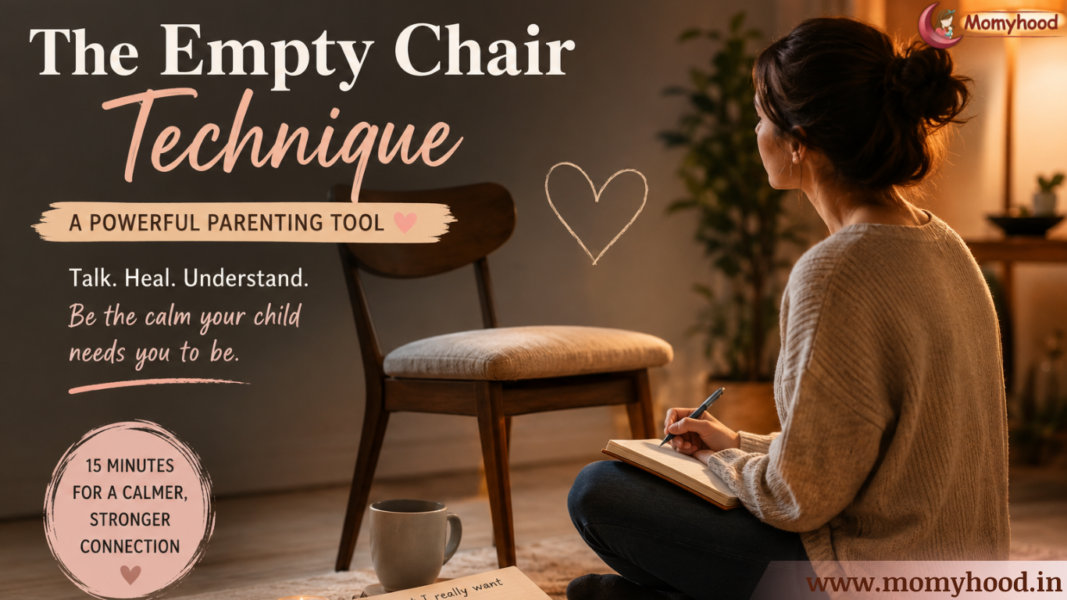
Can I be honest with you? There have been days when I said something to my child and immediately wished I could take it back. Days when I reacted too fast, too loud, too harsh — and then felt terrible about it for hours. If you have ever been there too, I want to tell you about something called empty chair technique parenting. It sounds a little strange at first. But it really works. And you can do it at home tonight, all by yourself, in just 15 minutes.
What Is the Empty Chair Technique in Parenting?
It is very simple. You take a chair and place it in front of you. Then you imagine your child is sitting on that chair. And you talk to them — out loud — as if they are really there.
That’s it. No special equipment. No therapist in the room. Just you, a chair, and your feelings.
This idea comes from therapy. Doctors and counsellors have used it for years to help people say the things they find hard to say in real life. Now, more and more parents are using the empty chair technique parenting method at home — and the results are really beautiful.
You can use this chair to talk to your child. Or your partner. Or even the younger version of yourself. Whoever is living rent-free in your head after a hard day.
The empty chair technique parenting is not about pretending. It is about getting your real feelings out in a safe place — before those feelings come out the wrong way with your child.
📣 Loved what you read? Want to go deeper into conscious parenting? ✨ The Power of Manifestation in Parenting is now available — A soulful guide packed with real-life tools like affirmations, energy shifts, and sleep talk that I personally use with my son, Hitarth. 💛 Start your journey toward calmer, connected parenting today. 🎉 Launch Offer: Only ₹99 (limited-time price!) 📲 Instant download. No waiting. 👉 Grab your copy now!.
Why Does It Actually Work?
Think about the last time you lost your temper with your child. Was it really about what they did? Or were you already tired, already stressed, already carrying something heavy from earlier in the day?
Most of the time, it is both. And children cannot always tell the difference. They just see a mom who is upset — and they feel scared or confused or shut down.
The empty chair technique gives you a chance to sort through your feelings before you bring them into the room with your child. When you talk to that empty chair, something interesting happens — you stop blaming and start feeling. Instead of “Why does he always do this?” you start to hear things like “I am scared I am losing him” or “I just want her to know I love her.”
Those are the real feelings. And once you say them out loud — even to an empty chair — they lose a little of their power over you. You feel lighter. Clearer. And your next conversation with your child goes better because of it.
Also read: Relationships Are Mirrors in Parenting: How Your Inner World Shapes Your Bond with Your Child
3 Real Mom Situations Where the Empty Chair Technique Helps
Situation 1 — When Your Little One Had a Big Meltdown
Your 4-year-old screamed in the middle of the market because you said no to a toy. You held it together outside. But at home, you were short and snappy with them for the rest of the evening. Now it’s bedtime and you feel awful.
Try sitting with the empty chair and saying something like:
“I am sorry I was grumpy with you tonight. You were tired and upset and you did not know how to say it. I was tired too. But I should have been kinder. Tomorrow I want to do better.”
This is practice. You are training yourself to lead with kindness instead of frustration. And the next time it happens — you will be more ready.
Situation 2 — When Your Teenager Has Gone Quiet
Your 13-year-old used to talk to you about everything. Now you get one-word answers and a closed door. Every time you try to connect, it feels like you are pushing them further away. You are hurt but you do not know what to say.
Try this with the empty chair:
“I miss talking to you. I know I cannot force you to open up. But I want you to know — I am not going anywhere. You do not have to have everything figured out for me to love you. I am here. Whenever you are ready.”
You may never say these exact words to your teen. But having felt them and said them out loud — your energy changes. You become calmer, less desperate. And teens feel that, even if they never say so.
Situation 3 — When You Need to Talk to Your Younger Self
This one is the most surprising. Sometimes the person who needs to sit in that chair is not your child at all — it is the little girl you used to be. The one who needed more patience, more love, more “I see you” — and maybe did not always get it.
“You did your best. Things were hard. But look at you now — you are trying so hard to be different for your own children. That takes real strength.”
Many parents who try this cry during this part. That is okay. This is where old patterns start to break. This is where the cycle stops.
How to Try the Empty Chair Technique at Home — Step by Step
Here is exactly how to do it. Follow these steps and you will be surprised how natural it starts to feel after the first two minutes.
Pick a quiet time
After the kids are asleep. Before the house wakes up. Any time you have 10 to 15 minutes alone. It works best when things have calmed down a little — not when you are still in the middle of feeling very angry.
Put a chair in front of you
An actual chair. Or a cushion. Or a pillow on the bed. Something physical that you can look at. This tells your brain — this is real, this matters. It sounds small but it makes a big difference.
Picture your child clearly
See their face. Their hair. What they were wearing today. Think about how they looked during the moment that is bothering you. The clearer the picture, the more real this will feel — and the more helpful it will be.
Speak out loud — not in your head
This is the most important part. Do not just think the words. Say them out loud. Yes, it will feel strange at first. That is completely normal. Just start talking — about what happened, how it made you feel, what you wish had gone differently.
Ask yourself — what is really going on?
If you feel angry, ask: what is under the anger? Most of the time it is fear, or sadness, or feeling unheard. This is the heart of the empty chair technique parenting process — going one level deeper than your first feeling.
Say what you really want
Finish by saying what you actually want — not from the fight, but from the relationship. “I want us to be close.” “I want you to feel safe with me.” “I want to stop shouting and start listening.” These words become your compass.
Sit quietly for one minute after
Do not rush to the next thing. Just sit. Breathe. Notice how you feel now compared to when you started. Most moms say they feel lighter, calmer, and clearer. That feeling — that is the technique working.
Related read: The Empty Chair Technique: How It Can Help Your Clients
What Changes When You Do This Regularly
When you practice empty chair technique parenting even once or twice a week, something quietly starts to shift.
You start to catch yourself before you react. That moment when you would normally snap — you notice it coming now. You get that tiny pause. And in that pause, you choose differently.
Your child feels this too — even if they never say it. A calm mom feels safe to a child. A child who feels safe does not need to act out to get your attention. They come to you instead.
Over time, your hard conversations get easier. Not because your child suddenly becomes perfect — but because you go into those conversations with less baggage. You have already said the hard stuff to the chair. What is left is just love.
And that is really what the empty chair technique is about. Clearing the noise so your love can actually reach your child.
A Few Things to Remember
It will feel awkward the first time. That is okay. Most moms feel a little silly talking to a chair. Push through that feeling. By minute three, most people forget they feel silly and just start feeling real.
You do not have to do it every day. Even once a week — or just after a really hard moment — is enough. Small and consistent beats big and occasional every time.
It is not a replacement for professional help. If things at home feel really heavy — for you or your child — please talk to a counsellor or therapist. The empty chair technique parenting practice is a great tool, but some things need more than a tool.
It takes courage to be honest with yourself. Sitting down and saying “I reacted badly today” or “I am scared I am not enough for my child” — that is not easy. But it is one of the bravest, most loving things you can do as a mom.
One Last Thing — From Me to You
The first time I tried empty chair technique parenting, I thought I was going to talk about my child. But after a few minutes, I realized I was talking to my own mother. About things I had never said out loud in my life. About the way I was parented and how it was quietly showing up in my own parenting — without me even knowing.
That one session did more for me than months of reading parenting books.
So if you are a mom who is trying her best, who messes up sometimes and feels guilty about it, who just wants to be a little calmer and a little closer to her child — please try this. Tonight if you can.
Put a chair in front of you. Say the thing you have been carrying. You do not need to perform it for anyone. You just need to hear yourself say it.
That is where things begin to change. Not out there. In here.
Have you ever tried something like this? I would love to know in the comments below. 🧡
And if this helped you, please share it with another mom who might need to read it today.
Your comments and shares do more than just support our blog—they uplift the amazing moms who share their stories here. Please scroll down to the end of the page to leave your thoughts, and use the buttons just below this line to share. Your support makes a big difference!