
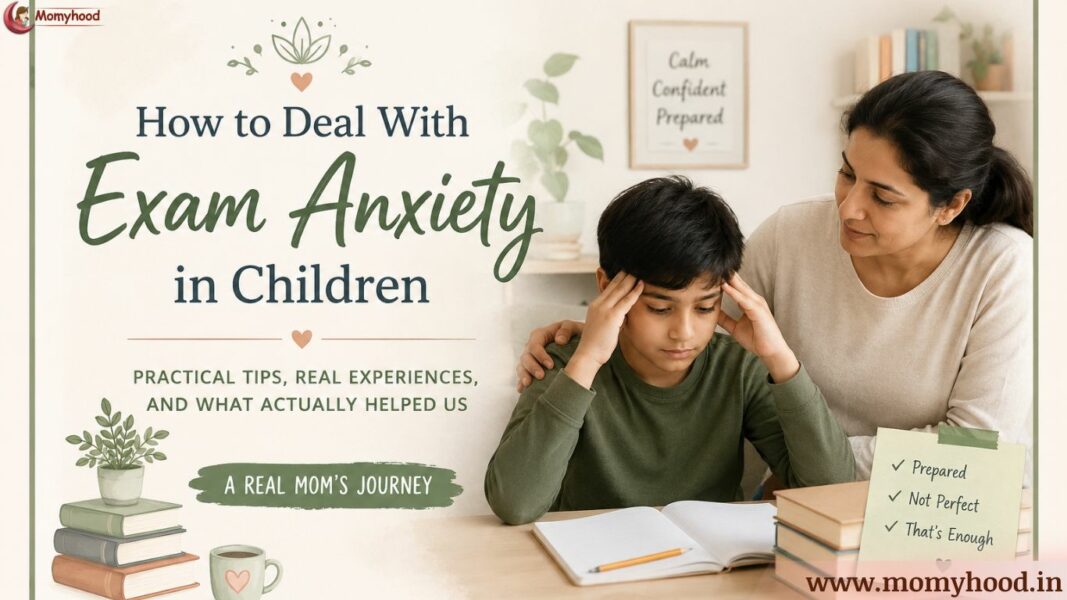
For a long time, I thought my son was fine before exams because he never once said the word “scared.” He didn’t cry, he didn’t refuse to go, he didn’t complain about the syllabus. It took me much longer than I’d like to admit to notice that his silence itself was the anxiety, not the absence of it. Learning how to deal with exam anxiety in children started for me not with a solution, but with finally seeing a problem I had been walking past for months.
This is the third post in what has become an ongoing series on our studying journey. The first was about finding what makes a child interested in studying at all, and the second was about building real self-study habits without nagging or reward charts. This one goes somewhere heavier.
The Evening I Realized It Wasn’t the Exam He Was Afraid Of
It was two days before his term exam, and he had gone unusually quiet at dinner. Not sulky, not upset in any obvious way, just quiet in a manner that didn’t match him at all. I asked if he was worried about the exam, expecting the usual “no, I’m fine.” Instead, after a long pause, he said something that stopped me completely: “What if I forget everything the moment I sit there?” It wasn’t the syllabus that frightened him. It was the fear of his own mind going blank in front of everyone, and the fear of what that would mean about him afterward.
What Exam Anxiety in Children Actually Looks Like, Beyond Obvious Nervousness
Before that evening, I assumed anxiety would look like tears, tantrums, or refusal, the way I understood or how it’s often shown in parenting articles. What I learned instead is that in many children, especially ones who are otherwise calm or high-achieving, exam anxiety hides itself very well.
The Physical Signs I Had Been Missing
None of these on their own seemed alarming. Together, they were his body’s way of expressing something he didn’t yet have the words for. I had been treating the stomach ache as a stomach ache, instead of asking what else was happening around the same time it appeared.
The Silence Before the Question
The other sign, harder to notice, was how long it took him to answer any question I asked about the exam. Not because he didn’t know the answer, but because he seemed to be checking, almost searching, whether his answer would disappoint me before he said it out loud. That pause was the real anxiety, far more than anything he eventually said.
📣 Loved what you read? Want to go deeper into conscious parenting? ✨ The Power of Manifestation in Parenting is now available — A soulful guide packed with real-life tools like affirmations, energy shifts, and sleep talk that I personally use with my son, Hitarth. 💛 Start your journey toward calmer, connected parenting today. 🎉 Launch Offer: Only ₹99 (limited-time price!) 📲 Instant download. No waiting. 👉 Grab your copy now!.
How to Deal With Exam Anxiety in Children: What We Actually Changed
1. Separating His Marks From His Sense of Worth
The biggest shift didn’t happen in how we studied. It happened in what I said, or didn’t say, around results. I realized I had been asking “how did it go” the moment he walked out of an exam, which unintentionally told him that the result mattered more than how he felt walking in or out of it.
What this looked like in our own house
I stopped asking about marks on exam day entirely. Instead, the first question became “how are you feeling right now,” and nothing about the paper itself until he brought it up himself, sometimes hours later, sometimes the next morning. The first time I did this, he looked almost confused, like he’d been expecting the usual question and it never came. Within a few exams, he started talking about how the paper went on his own, without me asking at all, because the pressure of an immediate verdict was gone.
2. Building a Night-Before Ritual That Had Nothing to Do With Revision
For months, the night before an exam was spent purely on last-minute revision, which in hindsight only added to his anxiety rather than reducing it. We replaced the last hour before bed with something deliberately unrelated to the syllabus.
What this looked like in our own house
We started a short routine of him telling me one thing he was looking forward to after the exam was over, no matter how small, a specific snack, a show, simply going back to normal evenings. Saying it out loud seemed to remind him that the exam was a single afternoon, not his entire identity. Some nights he added, almost as an afterthought, “and I know I’ve studied enough,” which he had never said unprompted before we started this.
3. Teaching Him What to Do With a Blank Mind, Instead of Just Telling Him Not to Panic
Telling a child “don’t worry” or “you’ll do fine” rarely helps in the actual moment their mind goes blank, because it gives them nothing to do with that blankness when it arrives. We needed something practical, not just reassuring.
What this looked like in our own house
We practiced a simple habit together: if his mind went blank on a question, he would skip it immediately, write down the numbers of any easier questions first, and only return to the hard one at the end. We rehearsed this at home using old question papers, treating a blank moment as something with a clear next step rather than something to fear. The first time he actually needed it during a real exam, he told me afterward that skipping the question felt strange but calm, instead of panicked.
A Few Lines We Said Together Before Every Exam
Alongside these changes, we added a few gentle lines the morning of an exam, said quietly together before he left for school:
- “I have already done the work, and that is enough.”
- “One paper does not decide who I am.”
- “If my mind goes blank, I know exactly what to do next.”
This didn’t replace any of the practical changes above, it simply gave the morning a calmer starting point.
What I Had to Unlearn as a Parent
The hardest part of this entire process wasn’t anything my son needed to change. It was noticing how much of his anxiety was quietly mirroring mine. I used to get visibly tense in the days before his exams, checking his revision schedule more often than necessary, asking questions that sounded supportive but carried an undertone of worry. Children read tone far more accurately than words, and I had to consciously soften my own reactions before I could expect his to soften.
Related read: Psychologist: This common issue can hurt kids’ future success, happiness—they won’t just ‘grow out of it’
How Long This Actually Took
This wasn’t a one-exam fix. The first time we tried the night-before ritual, it felt forced and awkward for both of us. It took roughly two exam cycles, spread across a few months, before any of it started feeling natural rather than like a new set of instructions layered on top of an already stressful time. What changed permanently was smaller than I expected: he started telling me when he felt anxious, instead of going quiet, which was the entire goal from that first dinner conversation.
If you’re trying to figure out how to deal with exam anxiety in children, the most useful thing I can offer is this: look past the absence of tears or tantrums, because anxiety in children often hides in silence, physical complaints, and small pauses rather than obvious distress. The fixes that helped us had less to do with the exam itself, and much more to do with what happened before and after it, and with how calm I was able to stay while he learned to be calm too.
This has been part three of our studying series, following the earlier posts on building interest and building self-study habits. If this helped, stay tuned, because there’s more from our journey coming soon.
Your comments and shares do more than just support our blog—they uplift the amazing moms who share their stories here. Please scroll down to the end of the page to leave your thoughts, and use the buttons just below this line to share. Your support makes a big difference!