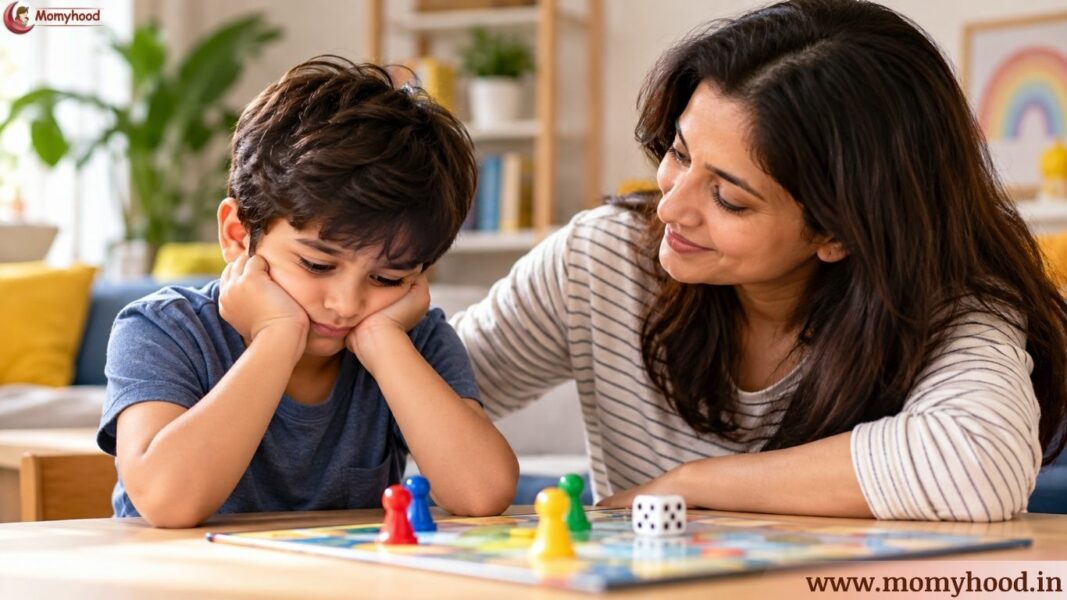
The Ludo board went flying across the room on a quiet Sunday evening. Dice, tokens and one very small red pawn scattered under the sofa. My son Vivaan, six years old and red in the face, was shouting that the game was “cheating” because I had cut his last token with one throw.
I sat there with a dice in my hand and a thought I could not shake: I had no idea how to teach kids it’s okay to lose. I had spent six years teaching him to eat, sleep, read and share. Nobody had told me that losing needed to be taught too.
That evening started a slow, messy, sometimes funny project in our house. I decided to treat every small defeat as a practice round, so that the big disappointments of life would not arrive as a total shock. Here is what I tried, what worked and what did not.
Why Losing Feels So Big to Children
Before I changed anything, I had to understand what was going on inside Vivaan. To a six-year-old, losing is not “I did not win this game”. It feels like “I am not good enough”, and that is a heavy thing to carry.
Young Brains Are Still Learning to Manage Feelings
Children under seven or eight are still developing the part of the brain that calms big emotions. When the game goes wrong, the feeling arrives fast and the ability to handle it arrives slowly. The flipped board was not bad character. It was a child with a feeling that was too large for his tiny toolbox.
We Praise Winning Without Meaning To
I also had to admit something uncomfortable. Without realising it, I celebrated wins louder than efforts. “Well done, you came first!” got a big smile from me, while “good try” got a quick pat. Children notice everything. Vivaan had simply learned what earned my happiness.
📣 Loved what you read? Want to go deeper into conscious parenting? ✨ The Power of Manifestation in Parenting is now available — A soulful guide packed with real-life tools like affirmations, energy shifts, and sleep talk that I personally use with my son, Hitarth. 💛 Start your journey toward calmer, connected parenting today. 🎉 Launch Offer: Only ₹99 (limited-time price!) 📲 Instant download. No waiting. 👉 Grab your copy now!.
How to Teach Kids It’s Okay to Lose at Home, One Board Game at a Time
Home is the safest place to lose. No one is watching, no trophy is at stake and mom is right there. That is why I chose board games as our first practice round.
Stop Letting Them Win Every Time
For years, I had quietly let Vivaan win at Snakes and Ladders because I wanted him to be happy. It felt kind, but I now think it was a mistake. A child who always wins at home meets his first real loss at school, in front of thirty classmates. So I stopped. I played honestly, and I let the dice fall where they fell.
Set the Rules Before the Game Begins
Before every game, we now say two things together: “We play fair, and we say well played at the end, whoever wins.” Saying it before the game, when everyone is calm, works far better than demanding good manners after a defeat, when he is already upset.
Name the Feeling, Then Move On
When he lost the next time, I did not rush to fix it. I said, “You look really disappointed. It is hard when we are so close to winning.” Naming the feeling calms a child faster than any lecture. Once the feeling had a name, he could breathe, and then we could talk about the next game.
Be a Good Loser Yourself
Here is the part that stung. When I lost, I used to grumble, “Oh, this dice hates me today.” Vivaan was copying me perfectly. So I started to lose out loud on purpose. “Oh, I lost! That is okay, I had fun. Let’s play again.” Children learn far more from what we do than from what we say.
How to Teach Kids It’s Okay to Lose: The Words I Use
Words matter more than we think. A single sentence can turn a defeat into a lesson, or into shame. These are the lines that live in our house now.
Lines That Help
- “You tried really hard, and I saw it.”
- “It is okay to feel sad. Feelings pass.”
- “Losing means your brain is learning something new.”
- “What was your favourite part of the game?”
- “What would you like to try differently next time?”
Lines I Avoid
- “Don’t cry, it’s only a game.”
- “You are being a sore loser.”
- “Stop making such a fuss.”
Dismissing a feeling does not make it disappear. It only teaches the child to hide it. When I ask myself how to teach kids it’s okay to lose, my answer now begins with listening, not correcting.
Sports Day: When Your Child Comes Last
Sports day arrived a few months later, and I will admit my heart was racing more than his. Vivaan was in the 50-metre race. He came fifth out of five.
What Happened on the Field
He did not cry. He walked over to me with a stiff face and said, “I was the slowest.” Everything in me wanted to say, “No, you were great!” But that would have been a small lie, and he would have known it.
What I Said Instead
I crouched down and said, “You ran the whole way, even when you were behind. That takes real courage.” Then I asked, “How did it feel in your legs?” He talked about his shoes, the dust and the boy who ran too fast. By the time we reached the ice cream stall, the race was a story and not a wound.
Praise the Effort, Not the Rank
Rank is something a child cannot always control. Effort is. When we praise effort, we give children something they can improve, and that makes losing feel less like a verdict and more like information.
Results Day: When the Marks Are Not What They Hoped For
Results day is the loudest kind of losing, because it comes with comparison. Cousins, classmates and neighbours all seem to know each other’s marks. Even in the early classes, children feel it.
Keep Your Face Calm First
Our first reaction is the real lesson. When I opened Vivaan’s report card and saw a mark lower than he had hoped for in maths, I made myself take one breath before I spoke. Children read our faces long before they read our words.
Ask Before You Advise
I asked, “How do you feel about this?” He said, “Bad. Everyone got more than me.” We sat with that for a minute. Only then did we talk about what had felt difficult in maths and how we could make it easier together.
Separate the Mark From the Child
I told him plainly, “This mark tells us what to practise. It does not tell us who you are.” That one sentence has done more for his confidence than any amount of “you are so smart”.
How to Teach Kids to Handle Losing: Everyday Practice Rounds
Losing is not only about games and exams. Life gives us small disappointments every single day, and each one is a chance to practise.
Little Disappointments Count Too
- The park is closed today.
- The friend was busy and could not come over.
- His favourite biscuit is finished.
- The team he supports lost the match.
Each time, I try not to rescue him quickly. I stay close, I name the feeling and I let him find his own way back to calm. Slowly, the recovery time has become shorter.
Share Your Own Losses
I also tell him stories of my own disappointments, such as the job I did not get, the blog post that no one read and the recipe that burnt. Children are comforted when they learn that adults lose too, and that we survive it.
Also read: It’s OK for kids to lose: 10 tips and tricks for playing games with the kids these holidays
Teaching Children About Disappointment and Loss
Some parents also wonder how to explain loss in a bigger sense, such as a pet that is gone or a friend who moved away. These are deeper subjects, and they deserve their own space. But the same foundation applies. A child who has learned to name disappointment, sit with it and recover from it is better prepared when a bigger sadness comes. Small losses are the training ground for large ones.
What I Got Wrong as a Mother
I still make mistakes. I once told Vivaan to “stop crying like a baby”, and I saw his face close like a door. I apologised that night. I said, “I was wrong to say that. Your feelings are allowed.”
I also pushed too hard in the other direction, giving a speech about resilience while he was still upset and not at all ready to listen. I learned to wait. The lesson comes after the feeling has settled, not during it.
Final Thoughts
If you are wondering how to teach kids it’s okay to lose, start with the smallest game in your house tonight. Play fairly, lose gracefully when it is your turn and say “well played” with a smile. Your child is watching you more closely than you think.
Vivaan still has bad days. Last week he lost at Ludo again, sighed loudly and said, “Okay, that was disappointing. Rematch?” I almost cried. That sigh was worth every flipped board.
Tell me in the comments: what is the hardest thing your child has had to lose at so far, and how did you handle it?
Your comments and shares do more than just support our blog—they uplift the amazing moms who share their stories here. Please scroll down to the end of the page to leave your thoughts, and use the buttons just below this line to share. Your support makes a big difference!