
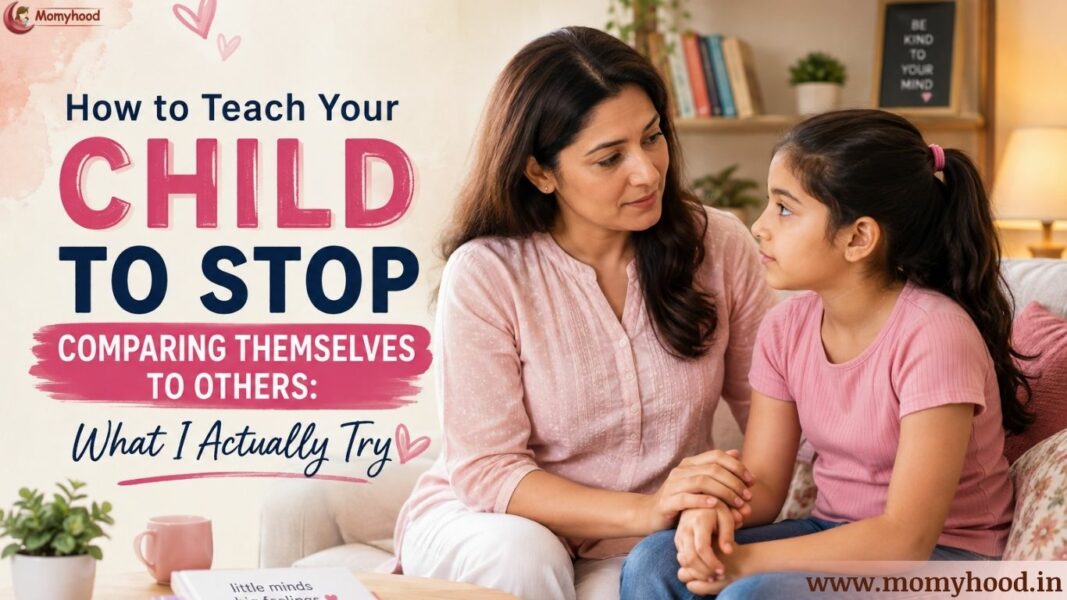
There are days when your child comes home and says, “Mumma, she is better than me.” Maybe a friend got higher marks, ran faster, made more friends, or simply seemed more confident.
My first instinct used to be to make my child feel better immediately. But I realised that saying “Don’t compare yourself” doesn’t really teach a child what to do with that feeling.
So instead of trying to prove that my child is better, I started helping them understand why they were comparing themselves to others and what they could focus on instead.
Key Takeaways
- A child comparing themselves to others is often trying to understand their own abilities or place among their peers.
- Comparison becomes unhealthy when children start believing that someone else’s success means they are not good enough.
- Listening to the reason behind the comparison helps parents respond to the real insecurity instead of simply giving reassurance.
- Personal progress gives children a healthier way to measure growth than constantly comparing themselves with friends or classmates.
- Specific praise for effort, improvement, and persistence can build confidence without making “being the best” the goal.
- Parents can reduce unhealthy comparison by avoiding comparisons between siblings, cousins, classmates, and friends.
What Does a Child Comparing Themselves to Others Mean?
A child comparing themselves to others is noticing another person’s abilities, achievements, appearance, friendships, or possessions and using them as a measure of their own worth or success.
Some comparison is completely normal.
Your child sees another child running faster and thinks: “I want to run that fast too.”
That can be motivating.
📣 Loved what you read? Want to go deeper into conscious parenting? ✨ The Power of Manifestation in Parenting is now available — A soulful guide packed with real-life tools like affirmations, energy shifts, and sleep talk that I personally use with my son, Hitarth. 💛 Start your journey toward calmer, connected parenting today. 🎉 Launch Offer: Only ₹99 (limited-time price!) 📲 Instant download. No waiting. 👉 Grab your copy now!.
The problem starts when the thought becomes: “She runs faster than me, so I am bad at sports.”
The same can happen with marks.
One child gets 95. Your child gets 82.
Instead of seeing it as one test, your child may start thinking: “She is smarter than me.”
And then: “I am not smart.”
That is where I would step in.
Not to tell my child that they are better.
But to help them understand what they are actually feeling.
Why Is My Child Comparing Themselves to Others?
Children compare themselves to others for many reasons, including wanting to understand their abilities, fit in with friends, gain approval, or make sense of differences between themselves and other children.
Sometimes the reason is obvious.
Your child lost a game.
Their friend got a higher mark.
Someone received an award.
A sibling got praised.
But sometimes there is something underneath the comparison.
When your child says:
“She is prettier than me.”
they may actually be asking:
“Am I good enough?”
When they say:
“He is smarter than me.”
they may mean:
“Am I smart enough?”
And when they say:
“Everyone likes her more.”
they may be wondering:
“Do people like me?”
So when I hear comparison, I try not to correct it immediately.
I first try to understand it.
Why Does a Child Comparing Themselves to Others Need Support?
A child comparing themselves to others may begin to connect their self-worth with being better, smarter, prettier, faster, or more successful than someone else.
Imagine a child who struggles with mathematics.
At first, they may say:
“I am bad at maths.”
Then they notice their friend finishing the worksheet faster.
Now they say:
“She is much smarter than me.”
Eventually, they may stop wanting to try.
“What’s the point? I will never be as good as her.”
This is the part that concerns me more than the comparison itself.
The American Academy of Pediatrics identifies statements such as “Everyone is smarter than I am” and “I never do anything right” as possible signs of low self-esteem, particularly when they occur alongside other changes such as giving up easily or withdrawing. (healthychildren.org)
So I do not want my child to believe:
“I have to be better than everyone else to feel good about myself.”
I want them to learn:
“Someone can be better than me at something, and I can still be confident in myself.”
That is a very different kind of confidence.
Why Is My Child Comparing Themselves to Others?
Children compare themselves to others for many reasons, including wanting to understand their abilities, fit in with peers, gain approval, or make sense of differences between themselves and other children.
Sometimes the reason is very obvious.
Your child loses a race.
Their friend gets a higher mark.
Someone receives an award.
A sibling gets praised.
But sometimes the reason is hidden.
Your child may be feeling insecure about something and using another child as the measuring scale.
Your Child May Be Comparing Their Strength With Someone Else’s Strength
Your child sees the other child’s best quality.
They may not see that child’s struggles.
For example:
Your child sees:
“She always gets perfect marks.”
They don’t see:
“She finds sports difficult.”
Or:
“He has so many friends.”
They don’t see:
“He also gets nervous in new situations.”
Children often compare their behind-the-scenes with someone else’s highlight reel.
Our job is to help them see the bigger picture.
Your Child May Be Looking for Reassurance
Sometimes:
“She is prettier than me.”
actually means:
“Am I pretty enough?”
Sometimes:
“He is smarter than me.”
means:
“Am I smart enough?”
And:
“Everyone likes him more.”
may mean:
“Do people like me?”
Once I started listening for the feeling underneath the comparison, I found it much easier to respond.
What Should You Say When Your Child Says, “They Are Better Than Me”?
When your child says someone is better than them, acknowledge the feeling first and then help them understand what they are actually comparing.
Imagine your child says:
“Mumma, she is so much better than me.”
You might automatically say:
“No! You are much better than her.”
It sounds supportive.
But think about the message underneath.
We are still discussing who is better.
So I would try:
“You feel like she is better than you at this. What happened?”
Let them explain.
Maybe they lost a game.
Maybe they got fewer marks.
Maybe the other child answered a question when they couldn’t.
Then you can respond to the actual situation.
For example:
“You may not be as fast as her right now, but you have improved a lot since you started practising.”
Or:
“You don’t have to be the best in the class. What would you like to get better at?”
That small change moves the conversation from:
“Who is better?”
to:
“What can I do?”
And that is the direction I want to encourage.
How Can You Help Your Child Compare Their Progress Instead?
Helping children compare their current abilities with their own previous progress gives them a way to measure growth without constantly ranking themselves against others.
This is one of the biggest changes I would make at home.
Suppose your child previously needed help with five maths questions but can now solve three independently.
Instead of:
“Look, your friend can solve all of them.”
say:
“Remember when you needed help with all five? Now you can do three yourself.”
That is a comparison too.
But it is a healthier one.
Yesterday’s version of your child becomes the measuring point, not another child.
You can use this with almost anything.
For School
Instead of:
“Your friend got 95.”
Try:
“What did you understand better this time?”
For Sports
Instead of:
“He runs faster than you.”
Try:
“You ran without stopping today. Last month, you needed a break.”
For Art
Instead of:
“Look how beautiful her drawing is.”
Try:
“I can see how much more detail you added this time.”
For Reading
Instead of:
“Your sister reads faster.”
Try:
“You finished a whole chapter by yourself today.”
The child slowly starts learning:
“I don’t have to beat someone else to feel proud of myself.”
How Can Parents Stop Comparing Their Child With Other Children?
Parents can reduce unhealthy comparison by focusing conversations on their child’s behaviour, effort, choices, and progress instead of using another child as an example.
This is probably one of the hardest parts because comparison can slip into our language without us even noticing.
We say:
“Look at your cousin. She already finishes her homework.”
“Your friend got better marks.”
“Why can’t you behave like him?”
“See how confidently she speaks?”
Usually, we are trying to motivate our child.
But the child may hear:
“I am not good enough.”
So instead of comparing, describe what you want your child to work on.
Instead of:
“Your sister keeps her room clean. Why can’t you?”
try:
“Let’s work on putting your things away after you use them.”
Instead of:
“Your friend got 95 marks.”
try:
“Which part of your test would you like to improve next time?”
Instead of:
“Why aren’t you as confident as her?”
try:
“What would make you feel more comfortable speaking in front of others?”
The difference is simple:
Comparison focuses on another child. Guidance focuses on your child.
Can Praise Help a Child Stop Comparing Themselves to Others?
Specific praise for effort, improvement, persistence, and problem-solving can help children develop confidence without making “being the best” the goal.
I would be careful with praise such as:
“You are the smartest.”
It sounds wonderful, but what happens when the child meets someone smarter?
Instead, try:
“You kept trying even when that question was difficult.”
Or:
“I noticed you practised every day.”
Or:
“You were nervous, but you still went on stage.”
These statements tell the child something useful about themselves.
They learn:
I can work hard.
I can keep trying.
I can handle difficult things.
I can improve.
The American Academy of Pediatrics also recommends praising children’s effort and specific positive behaviours rather than constantly focusing on outcomes. (healthychildren.org)
That kind of confidence does not disappear just because somebody else gets a higher score.
What If Your Child Compares Their Looks or Things With Friends?
When children compare their appearance or possessions with others, parents can acknowledge the feeling while helping them understand that looks and belongings do not determine personal worth.
Your child may say:
“She is prettier than me.”
Or:
“Everyone has better clothes than me.”
Or:
“He has the latest phone and I don’t.”
My first reaction might be to say:
“Who cares? You are perfect!”
But if your child genuinely feels different, they may not believe that answer.
Instead, I would ask:
“What made you feel that way?”
Then listen.
Maybe someone made a comment.
Maybe your child saw something online.
Maybe they simply noticed a difference.
You can then help them separate having something different from being less valuable.
For example:
“It is okay to like her clothes. But having different clothes doesn’t make one person better than another.”
Then bring the conversation back to your child’s own qualities.
“What do you like about yourself?”
“What are you proud of?”
“What kind of friend are you?”
The goal is not to convince your child that they are the best-looking or most talented.
The goal is to help them understand that their worth is bigger than one quality.
What If Your Child Says, “I Am Not Good at Anything”?
When a child says they are not good at anything, help them identify specific strengths, efforts, and improvements rather than simply arguing that they are wrong.
Imagine your child says:
“I am not good at anything.”
You might immediately say:
“That’s not true! You are good at so many things.”
But sometimes a child needs evidence rather than reassurance.
Try:
“Tell me one thing that has become easier for you this year.”
Maybe they learned to swim.
Maybe they can now read independently.
Maybe they helped a friend.
Maybe they finally learned to ride a bicycle.
Maybe they kept practising a sport even after losing.
These things matter.
Being good at something is not the only reason a child can feel proud of themselves.
Sometimes confidence comes from knowing:
“I can learn.”
“I can improve.”
“I can try again.”
“I can handle difficult things.”
That is the confidence I would rather build than confidence based only on being better than someone else.
How Can You Help Your Child Handle Comparison at School?
Parents can help a child handle comparison at school by helping them separate another student’s performance from their own identity and focusing on what they can control.
School is one of the easiest places for comparison to happen.
Children see marks.
Awards.
Sports results.
Class participation.
Friend groups.
Teachers’ praise.
Suppose your child comes home and says:
“Mumma, everyone is smarter than me.”
Instead of immediately telling them they are smarter, ask:
“Was there something specific that happened today?”
Maybe they received a lower mark.
Now you have something concrete to work with.
You can say:
“Okay. You didn’t get the mark you wanted. Do you want to see what you can improve before the next test?”
This changes the conversation from identity to action.
Your child is no longer:
“the child who is not smart.”
They are simply:
“a child who has something to practise.”
That is a much healthier message.
How Can You Help Your Child With Social Media Comparison?
Parents can help older children manage social media comparison by teaching them that online content often shows only selected parts of someone’s life.
A teenager may scroll through photos and think:
“Everyone is happier than me.”
“Everyone looks better than me.”
“Everyone has more friends.”
“Everyone is doing better than me.”
Instead of simply saying:
“Stop using Instagram.”
try starting a conversation.
Ask:
“How do you feel after scrolling for half an hour?”
Or:
“Do you think you’re seeing someone’s whole life, or just what they chose to post?”
That can help your child become more aware of what they are consuming.
The American Academy of Pediatrics also encourages parents to have ongoing conversations with children about social media and how online experiences can affect wellbeing. (healthychildren.org)
You do not have to have one huge conversation.
Sometimes a five-minute discussion after your child makes a comparison is enough to start building awareness.
What Should Parents Avoid When a Child Is Comparing Themselves to Others?
Parents should avoid turning a child’s comparison into another competition, dismissing their feelings, or using other children as motivation.
Try to avoid:
| Instead of saying… | Try saying… |
|---|---|
| “You are better than her.” | “You have your own strengths.” |
| “Don’t compare yourself.” | “What are you comparing yourself about?” |
| “You are smarter than him.” | “What would you like to improve?” |
| “Who cares what they have?” | “I understand why you noticed that.” |
| “You should be more confident.” | “What is making you feel unsure?” |
| “Look how well your cousin is doing.” | “Let’s focus on what you want to work on.” |
You do not have to find the perfect sentence every time.
The most important thing is to understand the feeling before trying to fix it.
What’s Next? Help Your Child Build Their Own Measuring Scale
The best way to help a child stop unhealthy comparison is to gradually teach them to measure themselves by their own progress, effort, values, and goals.
You can start with one simple change today.
The next time your child compares themselves with someone else, do not immediately correct them.
Pause.
Ask:
“What makes you feel that way?”
Listen to the answer.
Then ask:
“What part of this is something you can work on?”
If they say:
“She gets better marks.”
Ask:
“What would you like to improve before your next test?”
If they say:
“He is much better at football.”
Ask:
“Would you like to practise one skill?”
If they say:
“Everyone has more friends.”
Ask:
“What kind of friend do you want to be?”
Slowly, the child learns to move from:
“Why am I not like them?”
to:
“What can I do for myself?”
That is the shift we want.
And it will not happen after one conversation.
You may have to repeat it many times.
You may forget and compare your child yourself sometimes.
Your child may go back to comparing again and again.
That is okay.
You are teaching a skill, not correcting one sentence.
Conclusion
A child comparing themselves to others does not need to be told that they are better than everyone else; they need to understand that they do not have to be better than everyone else to feel good about themselves.
Your child will compare.
They will notice who runs faster.
Who gets better marks.
Who has more friends.
Who looks different.
Who has something they want.
That is part of growing up.
Our job is not to create a world where nobody is better at anything.
Our job is to help our child understand:
Someone else’s strength does not make my strength smaller.
So the next time your child says: “Mumma, she is better than me.”
Pause before saying: “No, you are better.”
Try: “What makes you feel that way?”
Listen.
Understand.
Then bring the conversation back to your child. “You don’t have to be better than her. Let’s see how you can grow from where you are.”
Because ultimately, I don’t want my child to keep asking:
“Am I better than them?”
I want them to learn to ask:
“Am I becoming better than I was yesterday?”
And I think that is a much more powerful kind of confidence.
Your comments and shares do more than just support our blog—they uplift the amazing moms who share their stories here. Please scroll down to the end of the page to leave your thoughts, and use the buttons just below this line to share. Your support makes a big difference!