
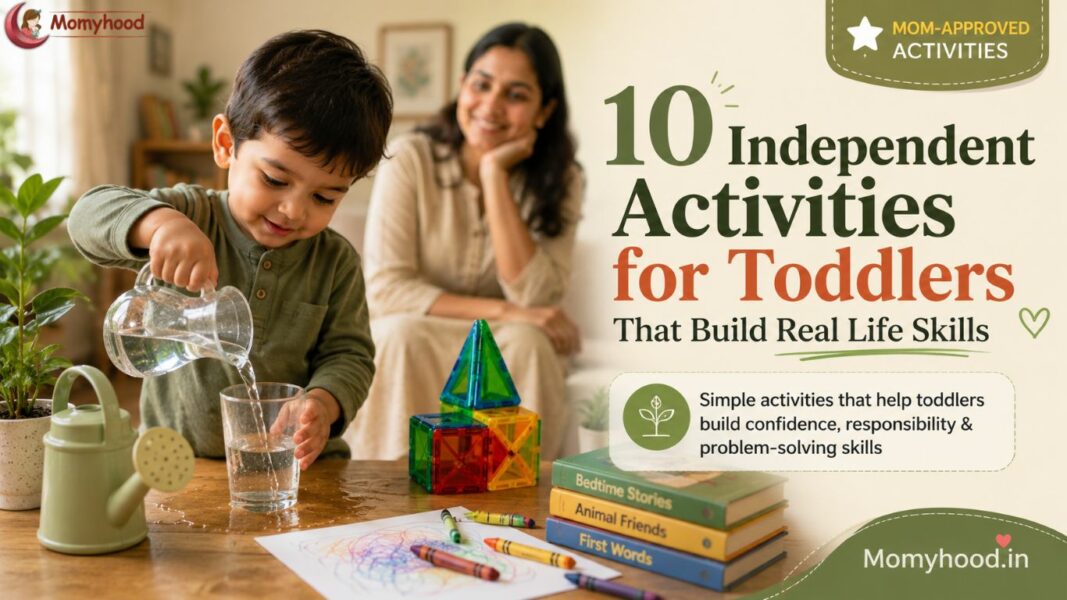
As a mother to Hitarth, who’s now 7, I still vividly remember his toddler years — back when he was around 3, curious and adventurous, and I was always on the lookout for independent activities for toddlers that did more than just keep his little hands busy. I wanted activities that actually built confidence, responsibility, and real problem-solving skills. Looking back at everything we tried, tweaked, and lived through during those years, the ones below are the ones that genuinely stuck — and the lessons from them still show up in who he is today.
Most lists of independent activities for toddlers focus on keeping kids occupied for ten quiet minutes — and that’s a real need too! But I’ve found the activities that worked best for us were the ones that doubled up as life lessons. Here’s exactly what we did at home, and why each one mattered.
Why Independent Activities Matter for Toddler Development
Independent activities for toddlers aren’t just a way to buy yourself ten quiet minutes, although that’s a real and valid reason too. At this age, children are wiring the parts of their brain responsible for confidence, problem-solving, and emotional regulation — and a lot of that wiring happens through unsupervised trial and error, not through being shown the “right” way to do something.
When a toddler pours their own water, builds their own block tower, or works out how to fix a spilled bowl of cereal, they’re not just completing a task. They’re learning that they’re capable, that mistakes are recoverable, and that they have some control over their own small world. That sense of capability is the real foundation independence is built on — long before the specific skill, whether it’s pouring, dressing, or drawing, even matters.
10 Independent Activities for Toddlers (That Actually Build Life Skills)
Pouring his own water (Problem-solving)
I let Hitarth pour his own water, even from a height where a spill was almost guaranteed. The first few times, water went everywhere — but instead of taking over, I’d hand him a cloth and let him clean it up himself. That shift, from “let me do it for you” to “let’s figure this out,” taught him more about adapting to challenges than any lecture could.
Helping in the kitchen (Life skills & teamwork)
Cooking together became one of our favorite rituals. Hitarth would stand on his stool, mix batter, stir dal, and carefully peel a cucumber under supervision. When something spilled or went wrong, we didn’t rush to fix it — we talked through what happened and how to avoid it next time. It turned the kitchen into a low-stakes classroom for measurements, patience, and teamwork.
Watering the plants daily (Responsibility)
Every morning, watering the plants became Hitarth’s job, not a chore I assigned out of convenience, but a small responsibility that was entirely his. Over time, he started reminding me if we’d forgotten, and noticing when a plant looked thirsty. That daily rhythm taught him more about routine and accountability than I expected from something so simple.
📣 Loved what you read? Want to go deeper into conscious parenting? ✨ The Power of Manifestation in Parenting is now available — A soulful guide packed with real-life tools like affirmations, energy shifts, and sleep talk that I personally use with my son, Hitarth. 💛 Start your journey toward calmer, connected parenting today. 🎉 Launch Offer: Only ₹99 (limited-time price!) 📲 Instant download. No waiting. 👉 Grab your copy now!.
Choosing his own outfit (Decision-making)
Letting him choose his own outfit each morning seemed like a small thing, but it gave him a genuine decision to own, right down to wearing mismatched colors some days. That tiny act of choosing built his confidence in making decisions, a skill that’s carried into much bigger choices as he’s grown.
Building with Magna-Tiles (Resilience & creativity)
When his tower wouldn’t stay up, my instinct was to fix it for him. Instead, I’d sit back and let him experiment — try a wider base, fewer pieces on top, a different shape entirely. Watching him work through trial and error, without my hands jumping in, is where I saw his problem-solving instincts really take shape.
Taking a turn at storytelling (Imagination & communication)
After I’d read him two stories at bedtime, it became his turn to make one up for us. His stories rarely made complete sense in the beginning, talking elephants with car keys, that sort of thing, but a real beginning, middle, and end started showing up over time. It became one of his favorite independent activities, and ours too.
Picking his own bedtime books (Curiosity)
Rather than choosing his bedtime books for him, I’d let Hitarth pick from the shelf himself. Some nights that meant the same book four nights running. But the act of choosing, rather than being handed something, nurtured a genuine curiosity and ownership over what he was learning.
“Talk about this object” extempore (Confidence & language)
Every day I’d hand Hitarth a random object, a toy car, a spoon, a phone, and ask him to talk about it for a few words. In the beginning he’d freeze or give one-word answers. Months in, he was confidently describing how things worked and why he liked them. It became one of my favorite techniques for building both language and quiet confidence.
Free drawing and pretend play (Focus & self-expression)
Given a blank page or an open-ended toy, Hitarth could disappear into his own world for long stretches, no instructions, no expectations, just him deciding what to create. Those stretches of unstructured, independent play did more for his focus and creativity than any structured activity we tried.
Displaying his own art (Self-worth)
We started putting his drawings and little projects up around the house, at his eye level, instead of tucking them away. Seeing his own work acknowledged, even something as simple as a scribble taped to the fridge, motivated him to keep trying new things on his own.
Also read: How to Manage Screen Time for Kids (Without the Guilt)
How to Set Up Independent Activities for Toddlers Safely
- Childproof the space first. A toddler can only explore freely if the area is genuinely safe to make mistakes in.
- Start with short stretches. Five to ten minutes is plenty at first; you can build up gradually as their focus improves.
- Stay close, but not hovering. Sit a few feet away rather than right beside them; it signals trust without leaving them unsupported.
- Model it once, then step back. Show them how an activity works the first time, then let them take over without jumping in at the first sign of struggle.
- Rotate activities every so often. New combinations of the same simple materials keep interest alive without needing constant new toys.
For more parenting tips and personal insights, follow me on Instagram.
The Parenting Principles Behind These Activities
Believe in their abilities before they do
The single biggest shift for us was choosing not to tell Hitarth he’s too small for something, and instead encouraging him to try. That belief becomes the foundation every one of these activities is built on.
Let mistakes be the lesson
A spilled glass of water or a wobbly Magna-Tile tower isn’t a failure, it’s the activity working exactly as intended. The learning is in figuring out what to do next.
Give real responsibility, not just busy work
There’s a difference between handing a toddler a task to keep them occupied and giving them something that genuinely matters, even in a small way. Watering a plant that depends on him, or choosing an outfit he’ll actually wear, carries more weight than a worksheet ever could, because the outcome is real.
Celebrate effort, not just success
We acknowledged every attempt, big or small. That recognition is often what kept a toddler coming back to try the next independent activity on his own.
Common Mistakes to Avoid With Independent Activities for Toddlers
A few small habits stopped these activities from really working in our house, until we caught them. Watch out for these:
Stepping in too soon
The moment a tower wobbles or water spills, the instinct is to fix it instantly. But that’s exactly the moment the learning happens. Give it a few extra seconds before jumping in, even when it’s tempting not to.
Over-praising every tiny action
Saying “good job” for absolutely everything, even things that took no real effort, ends up meaning nothing after a while. We saved real praise for genuine effort, like sticking with a tricky puzzle, so it actually landed.
Rushing the timeline
Comparing Hitarth’s pace to another toddler’s, or expecting an activity to “work” the very first time, only created frustration on both sides. Independence builds in fits and starts, not on a schedule.
Treating it purely as a convenience
If an activity is only ever framed as “something to keep him busy,” it stops being about building a skill and starts feeling like being parked somewhere. We tried to connect each one back to why it mattered, even briefly.
Choosing activities that are too hard, too soon
An activity that’s frustrating rather than challenging teaches a toddler to give up, not to persist. If something wasn’t clicking, we’d scale it back rather than push through.
Benefits You’ll Notice
- Plays independently for longer stretches — building Magna-Tile structures, drawing, or running pretend games without needing me involved.
- Handles simple daily tasks without help — pouring water, dressing, tidying up, all chip away at dependence on us for basic needs.
- Builds problem-solving skills that show up everywhere — a stuck zipper, a wobbly tower, a tricky puzzle, far beyond the original activity.
- Takes ownership of his own actions and decisions — from cleaning up a spill to wearing the outfit he picked himself.
- Communicates more clearly and confidently — thanks to daily storytelling and extempore practice that became second nature.
Related read: Beyond playgrounds: how less structured city spaces can nurture children’s creativity and independence
FAQs About Independent Activities for Toddlers
At what age can toddlers start doing independent activities?
Most toddlers show some readiness between 18 months and 2 years, with independent play and simple tasks becoming much more sustained by age 3 to 4, as we saw with Hitarth.
How long should independent playtime last for a toddler?
Start with just 5 to 10 minutes and build up gradually. By age 3 to 4, many toddlers can comfortably engage in independent activities for 20 to 30 minutes at a stretch.
What if my toddler refuses to play or do things independently?
Start smaller and stay nearby at first. Independence usually grows out of confidence, so a toddler who resists often just needs a few more rounds of doing the activity together before trying it solo.
Do independent activities for toddlers mean stepping back completely?
Not at all. It’s about giving them room to try while staying close enough to guide and celebrate the effort, not handing them a task and walking away.
Do independent activities for toddlers need expensive toys or materials?
Not at all — most of what’s on this list, water, plants, an outfit, a blank page, was already lying around our house. The activity matters more than the materials.
How do I know if my toddler is ready for more independent activities?
Watch for moments where they push back against help, wanting to do something themselves even if it’s slower or messier. That resistance is usually the clearest sign they’re ready for more independence, not less.
To Wrap Up
Looking back now that Hitarth is 7, it’s strange how much of who he is today traces back to these small, ordinary activities from his toddler years. Nurturing independence in toddlers was never about pushing him to do everything alone, it was about handing him real, age-appropriate activities, believing he could handle them, and stepping back just enough to let him try. If you’re standing at the start of that same stretch with your own toddler, I promise the spills and the slow mornings are worth it.
Your comments and shares do more than just support our blog—they uplift the amazing moms who share their stories here. Please scroll down to the end of the page to leave your thoughts, and use the buttons just below this line to share. Your support makes a big difference!