
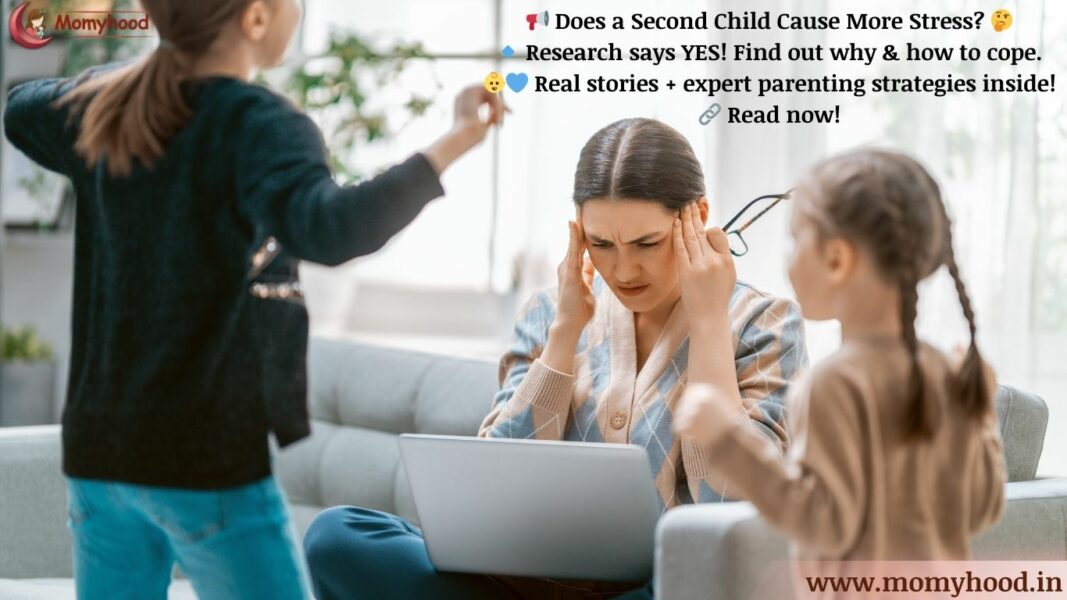
Not a sugar-coated answer. Just an honest conversation — whether you’re still deciding, or already knee-deep in it.
Maybe you’re lying awake at night wondering whether to have a second child. Or maybe you already have one, and you’re in the thick of it — exhausted, guilty, loving it and struggling at the same time — and you just need someone to tell you that what you’re feeling is normal.
Either way, this is for you.
So — is the second child harder than the first? Let’s be honest about it.
The Short Answer
Yes, for most parents, the second child is harder than the first. Research from the University of Melbourne tracked 20,000 families over 16 years and found that time pressure doubles after the second child — and mothers’ mental health declines more sharply than after the first. But knowing why it’s harder, and what actually helps, makes all the difference.
First, Let’s Acknowledge Something
Before we get into the “why” and the “how to cope” — can we just pause for a second?
If you’re already parenting two children and you feel overwhelmed, stretched thin, guilty, and tired — you are not doing it wrong. You are doing something genuinely hard. The fact that you care enough to feel guilty is proof that you’re a good parent, not a bad one.
📣 Loved what you read? Want to go deeper into conscious parenting? ✨ The Power of Manifestation in Parenting is now available — A soulful guide packed with real-life tools like affirmations, energy shifts, and sleep talk that I personally use with my son, Hitarth. 💛 Start your journey toward calmer, connected parenting today. 🎉 Launch Offer: Only ₹99 (limited-time price!) 📲 Instant download. No waiting. 👉 Grab your copy now!.
You probably expected the second child to feel more natural. You’d done this before, after all. You thought the experience would make it easier.
And then reality arrived — and it looked nothing like what you imagined. That gap between what you expected and what you’re living? That’s exactly what the research talks about. You’re not alone in it.
Why Is the Second Child Harder Than the First?
Here’s what the University of Melbourne study actually found — and why it matters for you specifically.
The researchers expected to find that experienced parents would handle the second child with greater ease. More knowledge, more confidence, more skill. Makes sense, right?
But that’s not what happened. The second child was harder across the board — and the reason is both simple and important: it was never about skill.
You can be the most competent, loving, prepared parent in the world — and two children will still demand more than one. Not because you’re failing. Because the math just changed.
The Time Problem
You only have so many hours. So much energy. So much emotional bandwidth. Your first child already uses a lot of it. Your second child doesn’t get what’s “left over” — they need just as much. So the total demand on you doubles, but you don’t. That gap is where the exhaustion lives.
The Guilt That Nobody Warns You About
Almost every parent says this — you feel like you’re constantly failing someone. Your older child isn’t getting as much attention as they used to. Your baby needs you constantly. Your partner is somewhere in the background. And you? You’ve disappeared somewhere in the middle of all of it.
This guilt is one of the biggest reasons the second child is harder than the first — and it’s almost never talked about openly.
“With my first, I felt stressed but present. With my second, I just felt… divided. Like no matter what I was doing, I was simultaneously failing at something else.”
Also read: To My Second Child
Your Relationship Takes a Hit
After the first child, couples typically find a new rhythm within months. After the second, that rhythm breaks again — and this time, there’s less time and energy available to rebuild it. Research consistently shows that relationship satisfaction drops more sharply after the second child than the first. This isn’t inevitable, but it does require deliberate attention.
Your Identity Gets Lost
With one child, many parents manage to hold on to small pieces of themselves — a hobby, a morning run, a friendship. With two young children, those pieces often disappear entirely. And when you lose your sense of self outside of parenting, everything else gets harder too.
If You’re Still Deciding: What You Actually Need to Know
If you’re considering a second child and wondering whether you can handle it — here’s the honest version that most articles won’t tell you.
-
Talk to your partner about the invisible load — before the baby arrives. Who is handling night feeds? Who takes sick days? Who manages the mental load of appointments, school communications, and playdates? Having this conversation before the baby comes is far less painful than having it in month three when you’re both running on empty.
-
Think about the age gap carefully. There’s no perfect gap, but there are real tradeoffs. A smaller gap means two children in nappies simultaneously; a larger gap means your older child is more independent but may also feel the shift more emotionally. Neither is wrong — just honest about what each involves.
-
Map your support system now. Who can you actually call at 7pm on a Tuesday when both children are sick and you have a work deadline? If the answer is “nobody,” that’s not a reason not to have a second child — but it is a reason to start building that network before you need it urgently.
-
Be real about the financial picture. A second child isn’t just double the cost — childcare for two can genuinely reshape what work looks like for both parents. Run the actual numbers before making the decision.
If You’re Already in It: What Actually Helps
You don’t need more information. You need something that actually works on a Tuesday at 6pm when both children are crying and dinner isn’t made.
-
Lower the bar — genuinely, not performatively. “Good enough” parenting is real parenting. Your children do not need a perfect parent. They need a present one. The days where you just about held it together count just as much as the days where everything went smoothly.
-
Give your firstborn 15 minutes of completely undivided attention every day. Not shared time. Just them, just you. No phone, no baby. This one thing dissolves a surprising amount of the guilt — and it works because it’s specific and consistent, not occasional and grand.
-
Say the hard thing to your partner out loud. Not “I’m fine” when you’re not. Not “it’s fine” when it isn’t. The couples who manage two children well are not the ones who never struggle — they’re the ones who say “I’m struggling” before it becomes a fight.
-
Stop scrolling other parents’ feeds when you’re already depleted. Social media comparison doesn’t just make you feel bad — it specifically attacks your confidence at your most vulnerable moments. You’re seeing someone else’s highlight reel at your lowest point. That’s not a fair comparison and it’s not useful information.
-
Find one thing that is just yours. Not a long list of self-care goals. One thing. A walk. A podcast. A cup of tea before anyone else wakes up. Something that reminds you that you exist outside of being a parent.
FAQs: Is the Second Child Harder Than the First?
Is the second child harder than the first for everyone?
For the majority of parents, yes — but not all. Families with strong support systems, shared household responsibilities, and realistic expectations tend to manage the transition more smoothly. The research shows the difficulty is real and widespread, but it’s not inevitable that it will feel unmanageable.
Does it get easier as the children get older?
Yes — and most parents say the hardest phase is when both children are under four. Once the younger child reaches three or so, the family typically finds a more sustainable rhythm. The acute exhaustion does pass, even when it doesn’t feel like it will.
Will I have enough love for two children?
This is one of the most common fears — and almost every parent of two says the same thing: love doesn’t divide, it expands. The anxiety about not having enough love is completely normal before the second child arrives. It almost always resolves itself once you meet them.
Also read: Is It Harder to Go From 0 Kids to 1, or 1 Kid to 2?
Is the second child harder on the marriage?
Research does show that relationship satisfaction drops more after the second child than the first. The key factor is not the children themselves — it’s whether couples talk openly about the load and actively protect time for their relationship. Couples who check in regularly do significantly better than those who assume things will sort themselves out.
I’m already struggling and I feel like a bad parent. What do I do?
You’re not a bad parent — you’re an honest one. Struggling with the second child is one of the most normal and least talked-about parts of parenting. The fact that you’re struggling and still showing up, still caring, still trying to do better — that is what good parenting actually looks like. Please talk to someone you trust about how you’re feeling. You don’t have to carry this alone.
You’re Doing Better Than You Think
The second child is harder than the first. That’s real, it’s researched, and it’s nothing to be ashamed of.
But it also gets easier. The guilt softens. The routine finds you. The older child stops resenting the baby and starts becoming their protector. And somewhere along the way, you stop surviving and start actually living it.
You don’t need to be perfect. You just need to keep going — and ask for help when you need it.
Your comments and shares do more than just support our blog—they uplift the amazing moms who share their stories here. Please scroll down to the end of the page to leave your thoughts, and use the buttons just below this line to share. Your support makes a big difference!