
Quick answer: Decide the limit, say it once calmly, and follow through with action instead of volume. You control what you will do, not what your child feels – let them be upset while you hold the line kindly.
Key takeaways
- A boundary is what you will do, not what you demand
- Say it once, then act
- Validate the feeling, hold the limit
- Consistency matters more than the exact words
As parents, we often find ourselves at a stage where we think how to set firm boundaries while maintaining a peaceful and loving home?
Yelling comes as a easiest way to get immediate results, but in the long run, it can lead to resistance, fear, or emotional distance between you and your child. Instead, using respectful, clear, and consistent communication can help establish boundaries effectively.
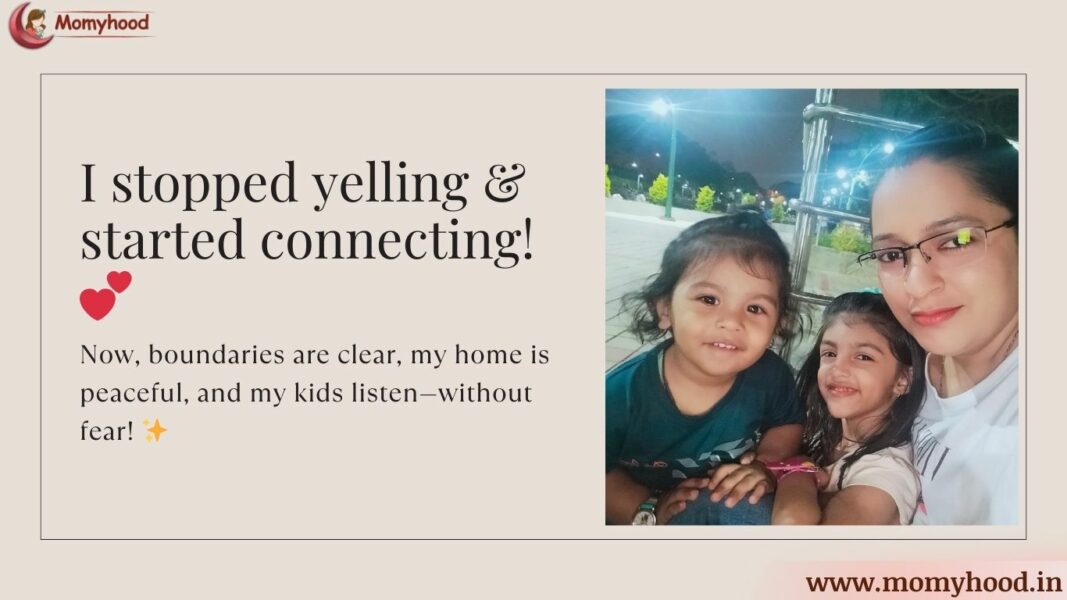
In this blog, I am sharing some practical strategies for setting boundaries without yelling, along with real-life examples from my journey with Shatakshi and Kiyansh to show how these techniques work in action.
Stay Calm and Use a Firm Yet Gentle Tone
Children often mirror our emotions. If we are calm, they are more likely to respond positively. A firm yet gentle tone conveys authority without instilling fear.
Example with Kiyansh
Kiyansh recently started hitting and pulling my hair as a playful act. Instead of shouting, I gently but firmly held his hands and said, “I will not let you hit me. Hands are for gentle touches. Let’s try again.”
📣 Loved what you read? Want to go deeper into conscious parenting? ✨ The Power of Manifestation in Parenting is now available — A soulful guide packed with real-life tools like affirmations, energy shifts, and sleep talk that I personally use with my son, Hitarth. 💛 Start your journey toward calmer, connected parenting today. 🎉 Launch Offer: Only ₹99 (limited-time price!) 📲 Instant download. No waiting. 👉 Grab your copy now!.
Then, I showed him how to touch my hair softly. Over time, he started understanding that hitting is not acceptable while still feeling safe to express himself.
Use Positive Language Instead of “No” or “Stop”
Rather than focusing on what children shouldn’t do, redirect them towards what they can do. This reduces frustration and helps them learn appropriate behaviors.
Example with Shatakshi
Shatakshi had a habit of throwing things when frustrated. Instead of saying, “Stop throwing!”, I tell her, “I see you’re upset. You can put the toy down gently or hand it to me.”
This not only acknowledges her feelings but also gives her an alternative action, making it easier for her to follow the boundary.
Set Clear and Consistent Expectations
Children thrive on predictability. Setting clear expectations beforehand prevents power struggles.
Example: Mealtime Struggles with Kiyansh
Kiyansh often wants to leave the plate after just a few bites. Instead of running behind him or yelling, I started using simple, consistent phrases like: ”During meals you have to sit at one place. If you get up, that means you’re done eating.”
After a few repetitions, he understood that meals happen at the particular and are not a game.
Offer Limited Choices to Give a Sense of Control – Giving children choices within boundaries helps reduce defiance.
Example: Getting Dressed with Shatakshi
Shatakshi often refuses to wear the clothes I pick for her. Instead of forcing her, I now offer two choices: “Would you like the red dress or the blue one?”
This small decision gives her a sense of control while keeping the boundary intact—she has to get dressed.
Use Natural Consequences Instead of Threats
Instead of threatening punishments, let natural consequences do the teaching.
Example with Kiyansh and Cleaning Up
When Kiyansh refuses to put his toys away, I say: “If the toys are not picked up, they will go in the ‘box’ until tomorrow and you will not get to play with it.
When he saw that his favorite toy was unavailable for a day, he quickly learned to clean up without me needing to yell.
Acknowledge Feelings While Holding the Limit
Sometimes, children push boundaries because they don’t feel heard. Validating their emotions can make them more receptive to rules.
Example: Handling a Tantrum with Shatakshi
When Shatakshi threw a tantrum because she wanted a dress at the store, I knelt down to her level and said, “I know you really want this dress. But we are not buying dresses today. You can add it to your wish list for later.”
She still cried but felt acknowledged, and over time, she learned that not every wish would be fulfilled immediately.
Model the Behavior You Want to See
Children learn more from what we do than what we say.
Example: Handling Frustration with Kiyansh and Shatakshi
On days when I feel overwhelmed, instead of snapping, I say out loud, “Mumma is feeling tired/annoyed. I will take a deep breath before I talk.”
This teaches them a healthy way to manage emotions without yelling.
Setting boundaries without yelling is not about being permissive—it’s about being firm yet kind. It requires patience, consistency, and a mindset shift from control to guidance. As I navigate this journey with Shatakshi and Kiyansh, I’ve learned that children respond best to boundaries set with love and respect.
If you’re struggling with boundary-setting, start small. Pick one strategy, apply it consistently, and observe the change. Your calm presence is the strongest tool in your parenting toolkit!
Latest updates for parents (2026–27)
Parenting advice keeps evolving. Here is what is new or worth knowing now about setting boundaries without yelling:
- Child psychologists now frame boundaries as “you are the leader of the family” – firm on the limit, warm in tone – a middle path between harsh and permissive parenting.
- The AAP advises against spanking and harsh verbal discipline, recommending clear limits, consequences and positive attention instead.
- For screens, many families now set boundaries with shared family media plans rather than daily arguments.
Watch: Dr Becky Kennedy on setting boundaries with kids
FAQs about setting boundaries without yelling
What if my child ignores the boundary?
Move from words to calm action: turn off the TV, hold their hand, or remove the toy, while naming what you are doing.
Is it okay to let my child cry when I set a limit?
Yes. Tears are a healthy way to process disappointment. Stay close and kind without giving in.
How do I stop yelling when I set limits?
Lower your voice, get down to their level and use fewer words. Planning your response in advance helps a lot.
Related reads on Momyhood
- How I overcame my anger issues as a mom
- Creative discipline methods
- Practical tips for a stubborn child
Sources: AAP HealthyChildren – Communication & Discipline; UNICEF Parenting.
Updated: November 2026
Your comments and shares do more than just support our blog—they uplift the amazing moms who share their stories here. Please scroll down to the end of the page to leave your thoughts, and use the buttons just below this line to share. Your support makes a big difference!



[…] Setting boundaries without yelling […]