
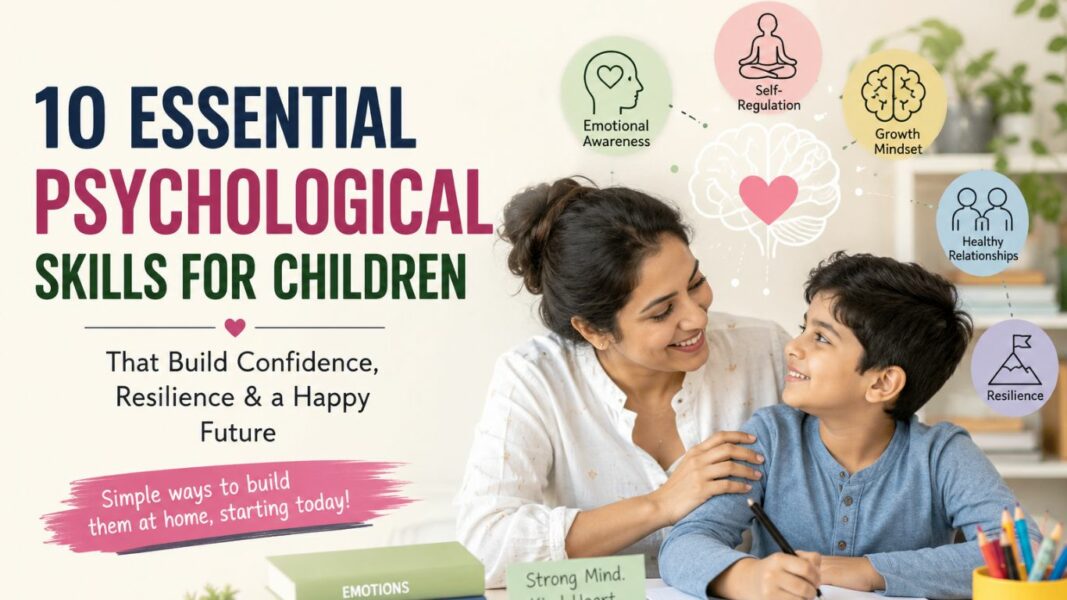
When I think about what I truly want for my son — beyond good grades and a decent career — it always comes back to one thing: I want him to be okay inside. That’s why the psychological skills for children we build in the early years matter so much more than any tuition class or extracurricular activity we enroll them in.
Marks fade. Trophies gather dust. But how a child handles failure, talks to themselves in hard moments, and builds relationships — that stays with them for life.
I’ve been a mom long enough now to see the difference between children who were only trained academically and those who were raised with emotional and psychological awareness. The difference is stark — and it shows not just in school, but in friendships, in resilience, in how they speak to themselves when things go wrong.
In this post: I’m sharing the 10 most important psychological skills for children that research supports and Indian parenting often overlooks — along with simple, everyday ways you can start building them at home, starting today.
What Are Psychological Skills for Children — And Why Do They Matter?
Psychological skills are the internal tools a child uses to understand themselves, manage their emotions, navigate relationships, and face challenges. Unlike academic skills, they’re not taught in school syllabi. Nobody gives your child marks for emotional resilience or self-awareness in Class 3.
But here’s what the research consistently shows: children who develop strong psychological skills early are more likely to succeed academically, maintain better relationships, and report higher life satisfaction as adults. A 2015 longitudinal study published in the American Journal of Public Health found that social-emotional skills in kindergarten were significantly predictive of success by age 25.
📣 Loved what you read? Want to go deeper into conscious parenting? ✨ The Power of Manifestation in Parenting is now available — A soulful guide packed with real-life tools like affirmations, energy shifts, and sleep talk that I personally use with my son, Hitarth. 💛 Start your journey toward calmer, connected parenting today. 🎉 Launch Offer: Only ₹99 (limited-time price!) 📲 Instant download. No waiting. 👉 Grab your copy now!.
In our Indian context, we focus enormously on what children achieve — but rarely on who they’re becoming on the inside. This list is my attempt to change that conversation, at least in our homes.
Emotional Awareness — Knowing What They Feel and Why
Before a child can manage any emotion, they have to be able to name it. This sounds simple, but most children (and many adults) live their entire lives confusing “I’m hungry” with “I’m anxious,” or “I’m embarrassed” with “I’m angry.”
Emotional awareness — the ability to identify, label, and understand one’s own feelings — is the foundation of every other psychological skill on this list. It’s also one of the most underdeveloped psychological skills in children because we, as parents, often rush to fix feelings rather than sit with them.
I remember my son coming home upset after a school test didn’t go well. My first instinct was to say, “Don’t worry, it’s okay!” But I’ve learned to slow down and ask first: “What are you feeling right now?” Giving him the language — “disappointed,” “embarrassed,” “frustrated” — has been genuinely transformative.
How to build this skill at home:
Play the “feelings check-in” game at dinner — each person names one emotion they felt that day and what caused it. Use picture emotion cards for younger children. Read storybooks that centre on characters’ feelings, not just their adventures.
Indian context note: We have a culture of “adjust karo” and “don’t cry in front of others.” But suppressing emotions doesn’t build strength — it builds pressure. Naming feelings is not weakness. It is the beginning of wisdom.
Self-Regulation — Managing Emotions Without Suppressing Them
Self-regulation is not about stopping a child from feeling angry or sad. It’s about helping them learn how to respond to those feelings without being controlled by them. This is one of the most critical psychological skills for children, and one that takes years to develop — with consistent support from us.
A child with poor self-regulation throws tantrums at 4, but also explodes at 14 and struggles with impulsivity at 24. The neural pathways being built right now in your child’s developing brain are literally the same ones they’ll use to manage stress as an adult.
How to build this skill at home:
Teach the “STOP technique” — Stop, Take a breath, Observe how you feel, Proceed. Practice it when emotions are calm, so it’s accessible in heated moments. Create a “cool-down corner” at home — not as punishment, but as a positive space to regulate. Model it yourself: say aloud, “Mummy is feeling very frustrated right now. I’m going to take a few deep breaths.”
Remember: Self-regulation is taught through co-regulation first. A calm parent is the most powerful tool you have.
Growth Mindset — Believing Effort Changes Everything
Dr. Carol Dweck’s decades of research at Stanford gave us one of the most practically useful concepts in child psychology: the growth mindset. A child with a growth mindset believes that their abilities can improve with effort. A child with a fixed mindset believes they are either “smart” or “not smart” — and that’s that.
The difference plays out every single day. When my son says, “I’m bad at maths,” that’s a fixed mindset statement. Teaching him to say, “I haven’t figured out this kind of problem yet” is growth mindset language — and it changes everything about how he approaches difficulty.
In India, we often praise children for being “brilliant” or “talented.” Dweck’s research shows this actually hurts them — because when they struggle (and they will), they conclude they’ve lost their brilliance. Praising the effort, the strategy, the persistence — that’s what builds a growth mindset.
How to build this skill at home:
Replace “You’re so smart!” with “I love how hard you worked on that.” When your child gives up on a task, ask: “What’s one small thing we could try differently?” Celebrate mistakes explicitly — say, “That didn’t work — brilliant, now we know something new.”
Related read: 5 Things I Tell My Child Every Day (That Are Secretly Shaping His Mindset)
Delayed Gratification — The Ability to Wait for What Matters
The famous Stanford Marshmallow Experiment showed that children who could wait for a second marshmallow (delayed gratification) went on to have better life outcomes across health, academics, and relationships. Decades of follow-up research has largely supported the core finding: the ability to delay immediate reward for a better future outcome is one of the most powerful psychological skills for children.
In our current world — instant reels, same-day delivery, instant results — this skill is under more pressure than ever. Our children are growing up in a dopamine economy designed to eliminate patience entirely.
How to build this skill at home:
Don’t rush to fulfil every request immediately. Let your child experience manageable waiting — “We’ll have that snack after we finish the walk.” Give them saving goals — let them work toward a small toy over two weeks. Board games and puzzles that require patience are powerful tools. So is cooking together and waiting for food to be ready.
Dadi ke zamaane ki baat: Grandparents knew this intuitively — making children wait for Diwali sweets, saving up for the annual fair. We’ve lost this rhythm. It’s worth bringing back consciously.
Empathy — The Ability to Feel With Others, Not Just About Them
Empathy is not sympathy. Sympathy is feeling sorry for someone from a distance. Empathy is the ability to step into another person’s experience and genuinely understand it. It is one of the most researched and valued psychological skills for children — and one of the best predictors of healthy adult relationships and leadership.
I’ve noticed that children who struggle with empathy are often children who were never asked how others might be feeling. We teach children to manage their own feelings. But we rarely teach them to consider the inner world of others — friends, siblings, classmates, the bai who comes every morning.
How to build this skill at home:
After your child tells you about a conflict with a friend, ask: “How do you think she/he was feeling in that moment?” Read books and watch stories from the perspective of different characters. Volunteer together — even small acts like distributing food at a local mandir or helping a neighbour — build empathy through lived experience, not just conversation.
Resilience — Bouncing Back Without Breaking
Resilience is one of the most overused words in parenting content — but also one of the most genuinely important psychological skills for children. It’s not about toughening children up or telling them “life is hard, deal with it.” Real resilience is built through supported experiences of difficulty — moments where children struggle, receive emotional support, and find their way through.
It’s the difference between shielding a child from every fall and being there to help them get up after the fall. One builds fragility. The other builds resilience.
In our homes, we often protect children from disappointment so thoroughly that they’ve never actually learned that disappointment ends. That it passes. That they survive it. That’s a dangerous gap to have at 18 when life gets genuinely hard.
How to build this skill at home:
Let age-appropriate struggles unfold without immediately rescuing. When your child is upset after a loss or disappointment, validate the feeling first — “That was really hard” — before moving to problem-solving. Share your own stories of failure and recovery. Normalise: “This is hard. And you can do hard things.”
Self-Awareness — Understanding Who You Are and How You Show Up
Self-awareness is the ability to observe your own thoughts, feelings, patterns, and behaviours — and understand how they affect you and others. It’s one of the least-discussed psychological skills for children, yet it underlies almost everything else on this list.
A self-aware child knows when they’re feeling overwhelmed before it becomes a meltdown. They know what kind of learner they are. They recognise when they’re being unfair or unkind — and can course-correct. They know their own strengths without needing external validation for it.
How to build this skill at home:
Keep a simple feelings journal together — even just one sentence a day. Ask reflective questions regularly: “What’s something you did today that you’re proud of?” “Is there anything you’d do differently?” Mirror back what you observe with warmth: “I noticed you got really quiet after school — are you okay?” This helps children learn to observe themselves through your caring observations of them.
Problem-Solving — Finding Solutions Independently and Creatively
Problem-solving as a psychological skill goes beyond the academic “solve this maths problem.” It’s the ability to face a real-life difficulty, think through multiple possible solutions, choose one, try it, and adjust if it doesn’t work. It’s a skill that requires both cognitive and emotional components — which is why it belongs firmly on a list of psychological skills for children.
One of the biggest mistakes I see (and have made myself) is solving children’s problems for them. When my son came to me upset about a fight with his best friend, my instinct was to give him a script. What I’ve learned instead is to say: “Let’s think together — what are three things you could try?” The shift from me-solving to we-thinking has made a real difference.
How to build this skill at home:
Use the “Three Solutions Rule” — when a child brings a problem, ask them to think of three possible ways to address it before you share yours. Play strategy games together — chess, carrom, board games that require thinking ahead. When things go wrong at home (broken item, schedule disruption), narrate your own problem-solving process aloud.
Healthy Boundaries — Knowing and Communicating Their Limits
We don’t talk enough about boundaries as a psychological skill for children — and we absolutely should. Teaching children that they have the right to say no, to their own bodies, their own comfort, their own emotional bandwidth — this is foundational for their safety and wellbeing throughout life.
Children who are never taught boundaries grow into adults who struggle to say no at work, in relationships, and with family. They become people-pleasers who are constantly exhausted and increasingly resentful. We can prevent that — starting now.
And yes, this includes our Indian tradition of forced hugs and “touch the feet of every relative you barely know.” Respecting a child’s body autonomy — even in small ways — teaches them that their “no” is valid. That is a gift for life.
How to build this skill at home:
Always ask before hugging or touching your child, and model asking for consent in play. Let children say no to physical affection with relatives — and back them up. Role-play situations where someone asks them to do something uncomfortable and practise saying, “I don’t want to” or “That doesn’t feel okay to me.” Validate “no” when they express it.
Gratitude and Positive Focus — Training the Brain Toward What’s Good
Gratitude is not about toxic positivity or dismissing real difficulties. It is, at its core, a cognitive habit — a trained tendency to notice what is good alongside what is hard. And the neuroscience is clear: regularly practising gratitude reshapes the brain’s default patterns toward positive emotional experience over time.
For children, building gratitude as a daily practice is one of the most underrated psychological skills. Not because life is all sunshine — but because children who habitually notice the good around them are more optimistic, more resilient, and better at forming positive relationships.
How to build this skill at home:
A simple three-item gratitude practice before sleep — “What are three things from today that were good, even small?” — is genuinely powerful when done consistently. Write gratitude notes together for teachers, neighbours, and family. Narrate your own gratitude aloud: “I’m really grateful we had this time together tonight.” Children learn the practice by watching it modelled.
Rooted in our culture: Shukriya and shukrana are woven into our traditions — thanking before meals, gratitude in prayer, acknowledging what we have. We can bring this into our daily language with children deliberately.
Also read: Emotional intelligence: An essential skill for children’s development
Quick Reference: All 10 Psychological Skills for Children at a Glance
Every child is different, but the psychological skills for children listed here are universal — they work across ages, temperaments, and backgrounds.
| # | Skill | Core Benefit | Starts Building |
|---|---|---|---|
| 1 | Emotional Awareness | Foundation of all emotional intelligence | As early as age 2–3 |
| 2 | Self-Regulation | Reduces impulsivity, improves decisions | Age 3–5 with support |
| 3 | Growth Mindset | Builds love of learning and resilience to failure | Age 4+ |
| 4 | Delayed Gratification | Better long-term life outcomes | Age 3–4 |
| 5 | Empathy | Healthy relationships and leadership | Age 4–6 |
| 6 | Resilience | Ability to recover from difficulty | Ongoing, all ages |
| 7 | Self-Awareness | Emotional intelligence and self-knowledge | Age 5+ |
| 8 | Problem-Solving | Independence and creative thinking | Age 4+ |
| 9 | Healthy Boundaries | Safety, confidence, healthy relationships | As early as possible |
| 10 | Gratitude | Positivity, optimism, wellbeing | Age 3+ |
Frequently Asked Questions About Psychological Skills for Children
At what age should I start building psychological skills in my child?
The earlier, the better — but it’s never too late. Many psychological skills for children, like emotional awareness and self-regulation, begin developing in infancy. By age 3, children are already building foundational emotional patterns. That said, parents of older children shouldn’t feel they’ve missed the window. The brain remains remarkably plastic throughout childhood and adolescence.
Are psychological skills different from social skills?
They overlap significantly. Social skills (like communicating, cooperating, sharing) are often the outward expression of psychological skills. For example, empathy is a psychological skill that supports strong social skills. Think of psychological skills as the inner foundation, and social skills as how they show up in interaction with others.
What if my child is already showing poor psychological skills — should I be worried?
Not immediately — but do pay attention. All children develop at different rates. However, if you notice persistent patterns of extreme emotional reactivity, inability to connect with peers, or significant anxiety or low self-worth, speaking to a child psychologist or counsellor is a healthy, proactive step — not a sign of failure.
Can psychological skills for children be taught in school?
Social-Emotional Learning (SEL) programs in schools are designed to do exactly this — and research shows they’re effective. But the home environment remains the primary place where these skills are modelled, practised, and reinforced. School can supplement; home is where it starts.
How does Indian parenting culture help or hinder psychological skills in children?
Both, honestly. Our culture has genuine strengths — strong family bonds, gratitude traditions, a sense of community and duty. These naturally support psychological skills like empathy, purpose, and gratitude. Where we sometimes struggle is in areas of emotional expression (suppression of feelings), autonomy (children’s “no” not being respected), and the pressure-performance cycle that can undermine growth mindset and self-worth. The good news: we can preserve what’s beautiful and consciously add what’s missing.
Final Thoughts: The Real Work of Parenting Happens Inside
I’ve written this not as a checklist to add guilt to your already full plate — but as a reminder that so much of what we do naturally, every day, already builds these psychological skills for children. Every time you name your own feeling out loud. Every time you let your child struggle with a puzzle without taking over. Every time you say, “I don’t know either — let’s figure it out together.”
These small moments are doing big work in the architecture of who your child is becoming. The goal isn’t to build a psychologically perfect child — it’s to build a child who knows themselves, trusts themselves, and can find their way back to okay when things get hard.
That, to me, is what success really looks like. And it starts at home. With us.
If this post resonated with you, save it, share it with another parent who needs it, and come back to it whenever you need a reminder of what really matters.
Your comments and shares do more than just support our blog—they uplift the amazing moms who share their stories here. Please scroll down to the end of the page to leave your thoughts, and use the buttons just below this line to share. Your support makes a big difference!