
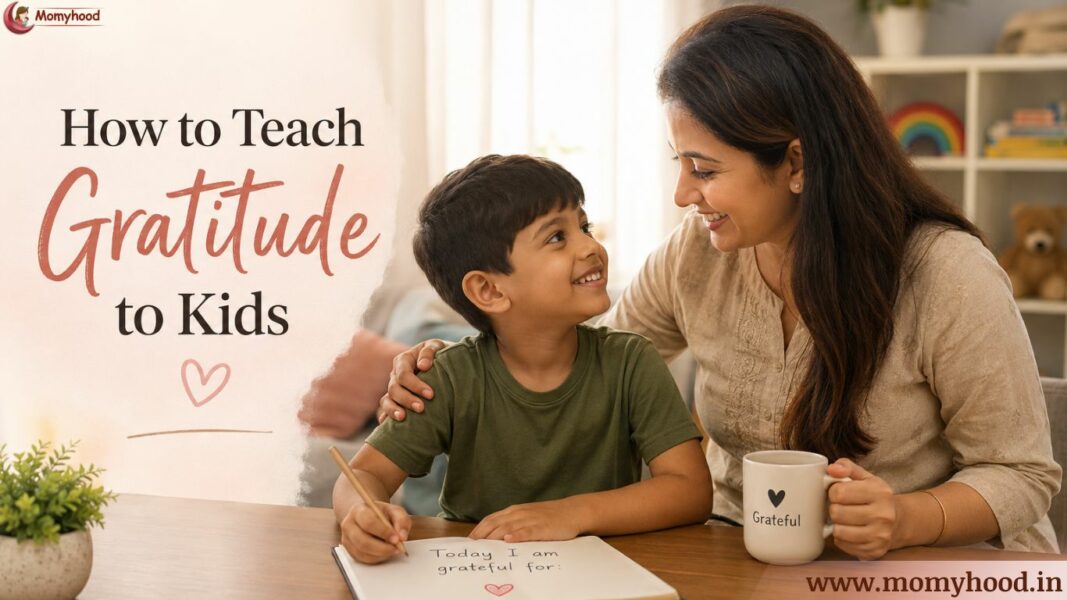
Every mom reaches this moment eventually — the toy cupboard is overflowing, the answer to “can I have this?” is almost always yes, and somewhere along the way you start wondering if your child even notices how much he has. That’s exactly where I found myself with my son, and it’s what sent me looking for real, practical ways on how to teach gratitude to kids — not lectures, not guilt-tripping, just small daily habits that quietly build the right mindset.
I’ll be honest — I used to think gratitude was something kids either “got” or didn’t. Some children just seemed naturally thankful, and others didn’t. But the more I’ve worked on this with my own son, the more I’ve realised gratitude isn’t a personality trait. It’s a habit. And like any habit, it has to be built, one small moment at a time.
Why Learning How to Teach Gratitude to Kids Matters More Than Ever
We’re raising children in a time when almost everything is one click away. A toy, a snack, a new pair of shoes — the waiting that used to teach patience and appreciation has mostly disappeared. My son doesn’t remember a world without instant deliveries and endless choices, and if I don’t actively step in, he won’t automatically understand that what he has is a privilege, not a given.
This is why I stopped treating gratitude as a “nice value to have” and started treating it as something I actively teach — the same way I’d teach him to read or ride a bicycle. It needs repetition, real examples, and patience.
7 Practical Ways I Teach Gratitude at Home
1. Talk in Numbers He Can Actually Understand
Kids don’t fully register abstract statements like “be thankful for what you have.” What works far better is making it concrete. When my son once asked for an expensive toy, instead of simply saying no, I broke it down for him — how many days our household help would need to work to earn that same amount. His face changed instantly. It wasn’t a lecture; it was just math, but it landed in a way “you’re lucky” never had.
2. Make “Thank You” a Habit, Not a Reminder
For a while, I noticed I was constantly prompting my son — “say thank you,” “what do you say?” That’s not gratitude, that’s just manners on autopilot. So I shifted the approach. Instead of reminding him after the fact, I started narrating gratitude out loud myself — thanking the delivery person, the person watering our plants, the security guard — so he’d absorb it naturally rather than being cued every time.
📣 Loved what you read? Want to go deeper into conscious parenting? ✨ The Power of Manifestation in Parenting is now available — A soulful guide packed with real-life tools like affirmations, energy shifts, and sleep talk that I personally use with my son, Hitarth. 💛 Start your journey toward calmer, connected parenting today. 🎉 Launch Offer: Only ₹99 (limited-time price!) 📲 Instant download. No waiting. 👉 Grab your copy now!.
Model It Before You Expect It
Children copy what they see far more than what they’re told. If they watch you genuinely acknowledge people — the didi who helps at home, the driver, the shopkeeper — with warmth rather than routine politeness, that becomes their default too.
Also read: 10 Psychological Skills for Children That Shape Who They Become
3. Involve Them in “Earning,” Even in Small Ways
One thing that shifted things for us was giving my son small, age-appropriate responsibilities tied to things he wanted. Not as punishment, but as a way to help him feel the effort behind getting something — helping set the table before dessert, tidying his shelf before a new book arrives. When something is even slightly earned, it’s valued differently than when it simply appears.
4. Create a Nightly Gratitude Habit
We started a simple bedtime ritual — before lights out, we each say one thing we were grateful for that day. Some nights it’s something big, most nights it’s something small and funny, like “I’m thankful mango season isn’t over.” The content matters less than the consistency. It trains his brain to actively scan his day for good things, instead of only noticing what he didn’t get.
5. Teach Respect for Every Person, Not Just Politeness
This is one of the pieces of learning how to teach gratitude to kids that I think gets missed the most. Gratitude isn’t only about saying thank you for gifts — it’s about noticing and respecting the people who make daily life easier. I’ve made it a point that my son greets everyone in our building respectfully, whether it’s the watchman, the cook, or the person delivering groceries. Not out of formality, but because every single person’s effort deserves acknowledgment.
6. Let Them Experience Mild “Not Having”
This one felt uncomfortable at first, but it’s been one of the most effective. I don’t rush to fulfil every request instantly. Sometimes I let my son wait a few days for something he wants, or ask him to save a little towards it himself. That small gap between wanting and getting is exactly where gratitude grows — without that waiting period, everything just feels ordinary and expected.
7. Talk About the “Why” Behind What They Have
Whenever it feels natural, I explain the effort or story behind something we have — how we saved for a holiday, how his school fees are managed, how his toys are a result of hard work and choices, not something that simply exists. Kids are far more perceptive than we give them credit for, and these small conversations build a quiet awareness over time.
Related read: R Madhavan revealed the harsh reality of life to son Vedaant to teach him gratitude
What Changed Once I Was Consistent
I won’t pretend this transformed my son overnight — it didn’t. But over a few months, I started noticing small shifts. He began thanking people without being told. He stopped comparing his toys to what his friends had. He once told our help, unprompted, “you must be tired, sit for a while” — and that one sentence told me more about progress than any big gesture could have.
Gratitude Is Built in Repetition, Not in One Big Conversation
If there’s one thing I’d want another mom to take away from this, it’s that figuring out how to teach gratitude to kids isn’t about one perfect talk you give them at the right moment. It’s dozens of small, repeated moments — a comment here, a habit there, a bedtime ritual, a respectful “namaste” to the guard downstairs — that slowly stack up into a mindset.
Some days I get it right, some days I forget and just let things slide. But the goal was never perfection — it was building a child who notices, appreciates, and respects what he has and the people around him. And that, more than any single lesson, is what I hope stays with my son long after he’s outgrown all these toys we once argued about.
Your comments and shares do more than just support our blog—they uplift the amazing moms who share their stories here. Please scroll down to the end of the page to leave your thoughts, and use the buttons just below this line to share. Your support makes a big difference!