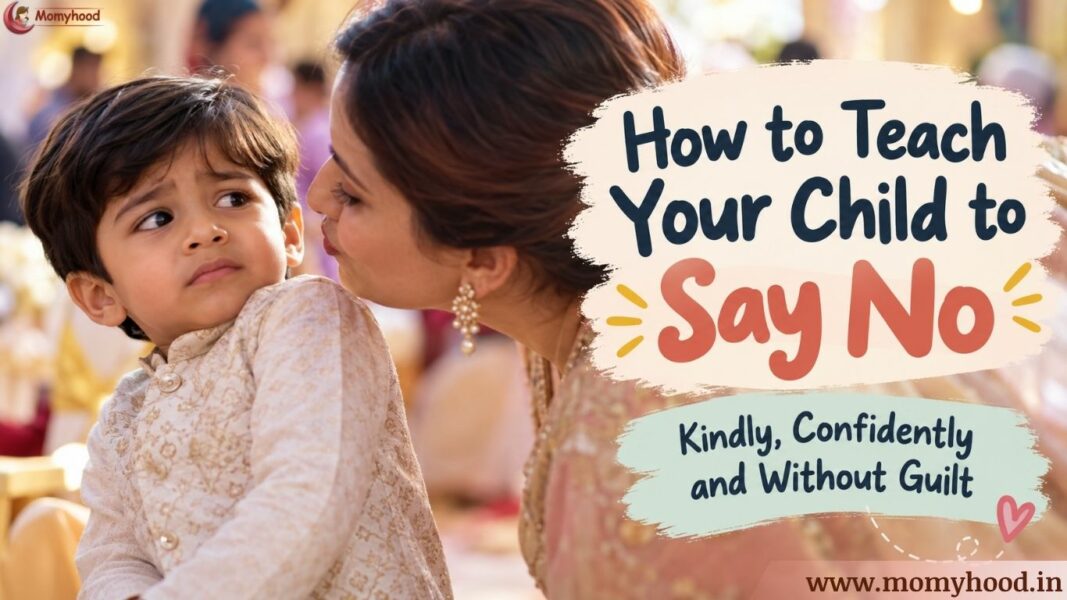
Last winter, at a family wedding, a relative I had met only twice bent down and asked my son Kabir for a kiss. He was three. He stepped behind my leg and held on to my dupatta. And I, wanting to avoid an awkward moment, said the words I wish I could take back: “Go on, sweetheart, be nice.”
He gave the kiss. The relative smiled, everyone clapped, and I felt relieved for about four seconds. Then I saw Kabir’s face. He wasn’t being nice. He was being obedient, and I had just taught him that other people’s comfort matters more than his own.
That night I could not sleep. I kept asking myself one question: how to teach child to say no, and to say it kindly, without guilt and without being called rude? I read, I asked other mothers, I made plenty of mistakes, and slowly our home changed. This is everything I learned, in the words I actually use with Kabir every day.
Why Saying No Is a Safety Skill, Not Bad Manners
Most of us grew up being agreeable. Say yes to the elders, share your toys, finish your plate, hug the aunty who pinches your cheeks. We called this good behaviour, and we proudly passed it on to our children.
But here is what I understood at 2 a.m. that night. A child who is never allowed to say no to a small thing will find it very hard to say no to a big thing. If she learns that adults decide who may kiss her, hug her or pull her onto their lap, then “no” stops feeling like her right and starts feeling like a risk.
A polite no is simply a boundary said with kindness. It is not defiance, and it is not bad parenting. It is a life skill, and it begins in ordinary moments like a refused hug or a toy that someone does not want to share.
📣 Loved what you read? Want to go deeper into conscious parenting? ✨ The Power of Manifestation in Parenting is now available — A soulful guide packed with real-life tools like affirmations, energy shifts, and sleep talk that I personally use with my son, Hitarth. 💛 Start your journey toward calmer, connected parenting today. 🎉 Launch Offer: Only ₹99 (limited-time price!) 📲 Instant download. No waiting. 👉 Grab your copy now!.
At What Age Do Children Learn to Say No?
Much earlier than most of us expect, and it happens in two stages.
The First No: Toddlers
Babies start shaking their heads and pushing away food before their first birthday. By about 18 months to two years, “no” becomes the favourite word in the house. I remember Kabir saying no to his bath, his shoes, his dinner and even his favourite biscuit, just because he could.
Many parents call this the “terrible twos”. I now see it differently. A toddler’s no is the first sign of a growing sense of self. He is discovering that he is a separate person with his own wishes.
The Polite No: Preschoolers and Beyond
The polite version comes later. Around age three to five, children begin to understand feelings and can borrow phrases like “No, thank you” or “I don’t want to right now”. So the honest answer to this question is simple: the no arrives first, and the polite way of saying it is something we teach slowly over the following years. Please do not punish the first one in a hurry to get the second.
How to Teach Child to Say No: Words That Work at Home
You do not need a special programme or expensive books. Short, repeatable sentences work best, because a scared or shy child cannot remember a long speech. These are the ones Kabir and I practise.
Phrases for Their Own Body
- “My body, my rule.”
- “Stop, I don’t like that.”
- “No, thank you. I don’t want a hug today.”
Phrases for Toys and Personal Space
- “I’m still playing with it. You can have it after me.”
- “Please don’t touch my things without asking.”
Phrases for Big Feelings
- “I don’t feel comfortable.”
- “I want to tell my mom.”
Practise Through Play, Not Lectures
Lectures bore children, but games do not. Kabir has a stuffed monkey called Bittu who is very pushy. Bittu tries to grab Kabir’s blocks, hug him without asking and take his snack. Kabir’s job is to say no firmly and politely. He loves it most when I play Bittu and lose the argument.
This kind of role play gives your child the words before they ever need them in real life. When something uncomfortable actually happens, the sentence is already sitting in their mouth, ready to use.
Body Autonomy: Their Body, Their Rules
This is the part many parents find uncomfortable, and I was one of them. So let me keep it simple and practical.
Use the Correct Names for Body Parts
Say them plainly, exactly the way you say elbow or knee. Children who have the right words can describe clearly if something ever happens. Silly nicknames can confuse a child, and confusion helps no one.
No Secrets About Touch
Tell your child that no one is allowed to touch them in a way that feels wrong, and that secrets about touch are never okay, even if the person says “it’s our little secret”. I say this to Kabir in a calm voice: “You can tell mom anything, even if someone told you not to. You will never be in trouble.”
Respect Their No at Home
This is the most important one. If you override your child’s no at home over a hug, a kiss or a tickle, the lesson they learn is that no does not work. When Kabir says “no more tickling”, the tickling stops at that very second, even when we are both laughing. It tells him that his words have power.
Handling Relatives Who Insist on Hugs and Kisses
This is where most of us feel the pressure. Nobody wants to look rude in front of family, and in our culture, saying no to an elder can feel like a crime. I know, because I felt it too.
Offer Greeting Options
What helped me was giving my child choices instead of orders. Before we meet someone, I ask, “Would you like to wave, give a high five, or fold your hands?” Every one of these is a respectful greeting, and the choice stays with Kabir. He feels safe, and the relative still gets a warm hello.
Step In With a Smile
When a relative insists, I step in lightly: “He is feeling shy today, but he is happy to wave.” I say it without apology and without an angry face. Most relatives adjust quickly. A few grumble, and that is okay. My son watching me protect his space matters far more than a few raised eyebrows.
How to Deal With a Child Who Says No
Here comes the honest part. Once you teach a child to say no, they will say it to you too. At bath time. At homework time. When it is time to leave the park. I would be lying if I said I never lost my patience.
What saved me was sorting every no into one of two kinds.
The Boundary No
“I don’t want to be tickled.” “I don’t want to hug her.” These are about my child’s body and feelings, so I respect them right away, every single time.
The Routine No
“I don’t want to brush my teeth.” “I don’t want to sleep.” These are not up for negotiation, but they can be handled with empathy.
What I Say for a Routine No
“I know you want to keep playing. Brushing is not optional, but you can choose which brush to use.” Giving a small choice inside a firm rule keeps the power struggle away.
Children can tell the difference when we stay consistent. Respecting a boundary no does not mean running a house where nothing is required. It means your child learns that their feelings are heard, even when the answer is still “not this time”.
What Is the Psychology Behind Saying No?
Behind every no, a child is learning two things: “I am a separate person” and “my feelings matter”.
Autonomy and Confidence
Child psychologists often link the early no to the growth of autonomy. When children are allowed healthy choices, they build confidence and decision-making. When every no is shut down, many children either grow into anxious people-pleasers or push back harder and louder to be heard. I have seen both types in my own friends’ children, and I did not want either for Kabir.
The Safety Connection
Children who are used to being heard find it easier to speak up when something feels wrong. They are also more likely to tell a trusted adult. This is the quiet strength hidden behind a polite no.
Age-Wise Examples You Can Use Today
Toddlers (1 to 3 Years)
Offer simple choices like “red cup or blue cup?” Respect harmless refusals, such as not wanting to give a goodbye kiss. Praise the no gently: “Thank you for telling me.”
Preschoolers (3 to 5 Years)
Introduce phrases like “No, thank you” and “Stop, I don’t like it”. Start naming body parts correctly and repeat the “my body, my rule” idea during bath time and dressing time.
Primary School (6 to 10 Years)
At this age the situations get more complex, so talk through them one at a time.
Peer Pressure
Tell your child it is perfectly fine to walk away from a friend who dares them to do something that feels wrong. A strong line helps: “I don’t want to, and I’m not changing my mind.”
Online Messages
Remind them they can always say, “I have to ask my mom first”, and that they will never be punished for telling you about a message that made them uneasy.
Also read: Teaching our kids they have the ability to say no empowers them with better reasons to say yes
A Few Mistakes I Made Along the Way
I forced hugs “just this once”. I told Kabir he was being rude when he refused. I laughed off his discomfort in front of other people. Every time, I undid a little of what I was trying to build.
If you have done the same, please do not be hard on yourself. I certainly was, for a week. Then I sat down with my son and said, “I should have listened to you at the wedding. From now on, your no matters to me.” He looked up and asked if he could still hug me. Of course he could. Children forgive so quickly when we are honest with them.
Final Thoughts
Learning how to teach child to say no is really about teaching them that their voice matters. A polite no is not rudeness. It is a child practising self-respect and, in the same breath, respect for other people.
Start small. Let your child refuse a hug, choose their own clothes or say “not now” to a game. Every small no that you honour builds the confidence they will need for the big ones, and that confidence will stay with them long after they have stopped needing you to speak up for them.
Tell me in the comments: what is one boundary your child set that surprised you?
Your comments and shares do more than just support our blog—they uplift the amazing moms who share their stories here. Please scroll down to the end of the page to leave your thoughts, and use the buttons just below this line to share. Your support makes a big difference!